Tuesday, July 11, 2006

Village Traditions

Jordan is a traditional society. Or, perhaps more specifically, Jordan is a country of traditions. For instance, just in the area of language, there are specific words and phrases it is appropriate to say when greeting people, when welcoming someone who has arrived safely after a long trip and when serving or receiving food. There is even a phrase that is used after a person receives a haircut. Also--as discussed in the previous post--there is the tradition of serving tea or coffee, which is part of a larger tradition of showing hospitality.

Although these traditions--along with many others--are of course evident in Amman, nowhere are they more visible than in the smaller towns and villages that dot the countryside. Annamarie and I have had the opportunity to experience this during our first three months in Jordan by visiting a small village of a few hundred people about an hour north of Amman several times with some friends. Some of the traditions in evidence there are:

THE GREETING
Exchanging kisses on the cheek--with those of the same sex--is an important part of most greetings in Jordan. However, in this particular village the greeting consists specifically of one kiss on each cheek followed by two kisses on the cheek on which the kissing began.

THE WATER
Upon arrival at someone's home in this village, a single glass of water is immediately brought out for the guests. This single glass is passed around and refilled until everyone has had their fill.

THE BEVERAGES
Soon after arrival, a beverage is brought out. As mentioned in the previous post, most times this is either tea or coffee. However, in hot weather, Pepsi, Coke or 7-UP is sometimes served instead. Soft drinks are also, though, sometimes served before coffee. In the village, we usually go around and visit many different families, and this means drinking a lot of tea and coffee. One day--which included visits to three wedding parties as well as visits to various homes--I drank a total of 11 beverages, all caffeinated except for one. This included four cups of Arabic coffee, three cups of tea, two Pepsi's, one Coke and one 7-UP. In case you're wondering, refusal to drink would be considered impolite.

THE PARLOR
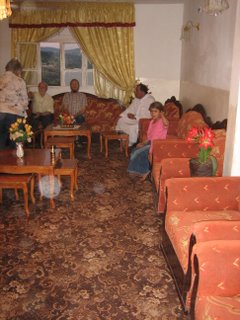
All of this greeting, visiting and drinking usually takes place in a specific room of the house or apartment set aside for such activities called the parlor. In this village, this typically is a large, rectangular shaped room with cushioned pads for seating set around the entire perimeter, with cushioned armrests in between each pad. Perhaps if the family has a little more money, this room will instead be filled--and I do mean filled--with furniture. The picture below is an example of a parlor with furniture. The couches and chairs are arranged in the same manner that the cushioned pads would be.
THE MAIN MEAL
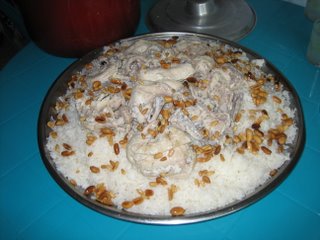
Jordan's national dish is called Mansaf. Served on a large tray, it consists of a huge bed of rice, on top of which is either boiled chicken or lamb, topped with roasted almonds or pinenuts, and a tart, watery yogurt. Although probably not common in Amman, traditionally people eat Mansaf by rolling the rice and chicken into a ball with their hands. The family we first met from this village has this meal every Friday. Below is a picture of Mansaf, as well as one of us and this family digging in with our hands.
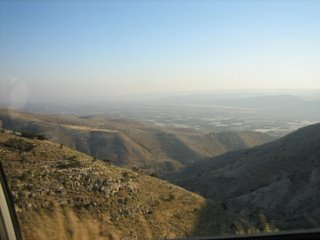
These are just a few of the traditions of this village that we have come to know. Below is a picture looking out towards the Jordan Valley, taken on an excursion with the family above.
Friday, June 30, 2006

Ahweh Daaymi 'Inshallah


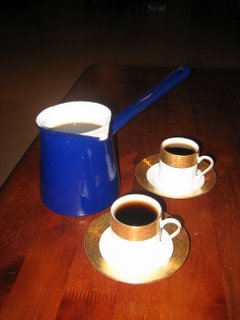
Ahweh Daaymi Inshallah--Coffee Always, if God wills--is a phrase used sometimes in Jordan, and no visit to a Jordanian's home is made without an offer of strong Arabic coffee or tea. Whether early in the morning, the middle of the day or late in the evening, coffee or tea is usually part of the visiting experience. Annamarie and I experienced this even while looking for an apartment, as after ringing the doorbell of a building and asking if any apartments were available, we were often invited inside for coffee. Arabic coffee--which is ground with cardamom--is rarely made without sugar, and is instead made either with medium sugar (wasat) or sweet (helway). It is boiled together with the sugar in a pot like the one in the picture above. Typically, the water is supposed to rise three times--each time taking the pot off of the heat to prevent an overflow--before pouring it into cups like those above. We've had a lot of coffee in our short time here, and so far at least, it seems that God is indeed willing.

Saturday, June 24, 2006

The War in Iraq from Jordan

It did not take long for Annamarie and I to experience the great difference between the effects of the war in Iraq from Jordan--a country a that borders Iraq--as opposed to America, a country 6000 miles away. Although both Iraqis and Americans continue to die every day in this war, in the States it seems that after three years, as a "news story" it has mostly faded into the background. It has in a sense become like a fan in the summertime that runs continually. It's noisy at first, but after a while it just blends in with the rest of the noise and becomes part of your life. You notice it only if everything else is quiet, or if it gets turned up one or two notches above its usual setting.

Here, though, it is impossible to avoid the war, whether it be in the daily news or in every day experiences. For example, an organization called the Jordanian-Iraqi Resettlement Project is not far from our new home, and black-robed Iraqi widows--sitting cross-legged on the pavement while selling cigarettes, tissue or other small items--are an ubiquitous presence in many market areas.

In our own small way, however, we experienced the impact of the war in Iraq while scouring Amman for an apartment. As we wrote in our previous posting, various sources indicate that around one million Iraqis have fled to Jordan over the past three years, and as we searched the city for a place to live, the influx of such Iraqis was a constant refrain from nearly every person we spoke to. First, our ex-patriot friends warned us that rental prices for apartments had increased because so many Iraqis--many of them wealthy or at least middle class--had come and rented or bought apartments. Then our Jordanian friends gave us the same information. At the same time, we found it difficult to find an unfurnished apartment because so many landlords were setting up furnished places in order to rent to those coming from Iraq. Such people are, perhaps, hoping not to stay long.

More concretely, though, we experienced the impact of the war as we came across Iraqis on our apartment search. One time, for instance, after ringing the front door of a building to ask about potential vacancies, we were greeted by a young Iraqi man whose large family lived on the first floor. They were indeed moving soon, he said, but the apartment was furnished, which we did not want. Another time we actually found ourselves in competition for an apartment with a group of Iraqi men. We just happened to arrive to ask about a certain third floor apartment five minutes before they did, and they waited patiently on the street while we looked at it with the landlord. We had a friendly chat with them afterwards, and then they went up to see it. Whether they rented it or not we don't know.

Finally, just a few blocks away from this building we stopped at another building to ask about vacancies. This time we were greeted by an elderly Iraqi doctor who said he had come to Jordan to escape the violence in his homeland. He and his family were actually moving again the next day to a place that was being built, but as usual, the apartment they were leaving was furnished. He had come to Jordan with his sons--we're not sure about his wife--but he left his daughter at home so she could finish university. To make her leave, he said, would cause her hard work to go for naught. We chatted about the situation in Iraq for a few more minutes, during which time his countenance dropped and his voice grew sad and resigned. He said he had hoped that Iraq would become like Europe after World War II, which was equalldevastateded but grew again with America's help. Iraq, though, he said, was instead getting worse, as the hopelessness in his voice could attest to. "It is civil war," he said. We told him we were sorry for what was happening in his country.

At this point it was getting late, and after a few more minutes we told him we needed to go. He bid us goodbye, and invited us back for tea the next morning. We could not come, however, as our search for an apartment would need to continue. As we learned, though, because of the impact of the war, it was a search that many were undertaking along with us.

Monday, June 19, 2006

Welcome to Jordan

We have been here in Jordan for about two months now and we finally have some time--and internet access from our home--to start our blog. Many of you have already received this via email, but since it sums up our first few weeks back in Jordan, we thought we'd make it our first entry and add some pictures. So, "Welcome to Jordan!" It's a phrase we hear often in taxis and on the street, and we hope reading our entries and seeing our pictures helps to convey a sense of what life is like in our new home.

CHANGES TO AMMAN
Amman has changed a lot since we were last here four years ago. The basic change we have noticed is that Amman is bigger and busier. Large, new roundabouts and overpasses have been built, and more are being constructed. Once vacant lots—and once vacant areas—have become the location of new apartment buildings, and many more such buildings are being built. New businesses have sprung up—such as Starbucks—and malls with western shops have been built as well. More cars are on the road, and traffic is heavily congested. With few traffic rules and more cars on the street we have fun taxi rides every time we get on the road! Urban sprawl has definitely come to Jordan!

POPULATION GROWTH
It is clear that Amman has grown. We have heard from different sources that almost 1 million Iraqis have come to Jordan since the start of the war in Iraq, and everywhere we go people are talking about their influence. Just on our apartment searches we have met Iraqis either moving out of places or looking for places. We have also heard that other Arabs from the Gulf are building second homes and vacation places here as well, adding to the growth.

FINDING HOUSING – The Divine Wrong Turn
The increase in population made it a bit difficult for us to find a place to live that was conveniently located near our school and affordable. We spent about 12 days walking the streets of Amman looking for empty apartments and inquiring about them. We saw apartments that ranged from palatial to those that looked like they were used as meth lab houses. We can now effectively help anyone who is planning on relocating to Amman with finding housing, as our Arabic on the subject is quite good. We are happy to report, though, that after about two weeks we did find an apartment, something that was made possible in part through Matt getting sick on a chicken kabob. This is because his sickness forced him to be homebound for two days (we have been staying with some friends), requiring Annamarie to go out looking without him. On the second day of his sickness, she found a place and called him to come look at it. He did, but even after over two hours of wandering around a certain area, he never found the place where she was waiting. In his first ten minutes of wandering, however, he did come across a different empty apartment, which he inquired about. We both went back later that night, and again the next afternoon to sign a year lease. It was almost exactly what we were looking for. Since this place ended up being our new apartment—and since any ill feelings Annamarie felt after waiting for what seemed like an eternity were replaced by joy and happiness—Matt likes to call this event the “Divine Wrong Turn.”

OUR APARTMENT
Our new apartment is mish mofrush—unfurnished—which means that it is rented totally empty. This means that we needed to shop for appliances such as a fridge, stove and washer, not to mention basic items like chairs and a bed. We do like our apartment and are glad to have our own place. We do have an extra bedroom so we are ready for visitors! We live close to school – only a 20 minute walk. There are cockroaches and an intermittent sewer smell but those are things that are common in Amman.


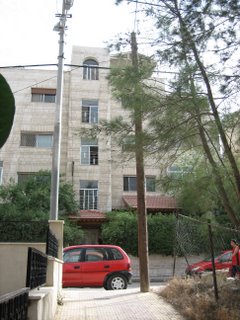
Our Apartment building. Our apartment is on the right, above the red tile overhang.


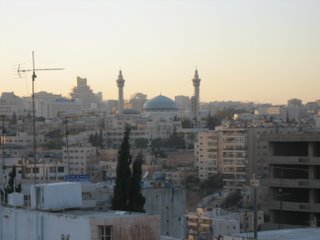
The view from the roof of our apartment building. The blue mosque is the King Abdullah Mosque, completed in 1990 and named after the grandfather of the late King Hussein.


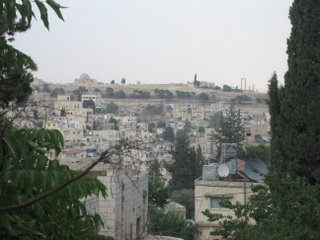
The view from the end of our street. On the left is a palace--rebuilt--of the Muslim Umayyad Dynasty from the eighth century. On the right are the remains of the Temple of Hercules, built by the Romans in the second century. The hill is said to be the site of Rabbah, the Ammonite city where Uriah the Hittite was killed.

Saturday, February 25, 2006

Inaugural

leaving for jordan - the start of the long goodbye has begun and we are soon to be leaving family and friends in April.