Last Sunday 60 Minutes broadcast a short piece on "Christians of the Holy Land," which reported on the dwindling number of native Christians in Israel and the Israeli-occupied West Bank that may eventually leave historically important cities like Jerusalem and Bethlehem without an indigenous Christian population. The short, 14 minute video is included below.
Saturday, April 28, 2012


Friday, April 20, 2012
Details
Two months ago when we left the United States to come back to Jordan, it seemed as if the news cycle there was beginning to move on from the so-called "Arab Spring." After all, there was the long-running Republican presidential nominating marathon to cover, as well as dire global economic news from countries like Greece, and the always popular stand-off with Iran over their nuclear weapons program, among other things. Here, though, the details of the Arab Spring are still obviously important, daily news, and this was highlighted again for me yesterday with two short articles from the English language Jordan Times newspaper. Both articles deal with the kinds of details that tend to get lost amid the flash and clamor of bombs and gunfire, and both draw attention to the human consequences that such flash and clamor bring.
Around 60,000 Libyans came to Jordan as a result of the revolution against former leader Muammar Gaddafi last year, and one article reveals that hotels in Jordan have recently decided to stop accepting them due to non-payment of bills. Apparently, the hotels are still owed around 90 million Dinars. The article goes on to say that hospitals in Jordan are still owed around 100 million Dinars from Libyans who came for war related medical treatment. According to the story, around 12,000 Libyans currently reside in hotels here, and a total of around 50,000 have come for medical treatment.
Right now there are reportedly around 100,000 Syrian refugees in Jordan due to the ongoing conflict there--a number that is said to be increasing by 500 people per day. The other article reports on the growing number of them arriving with various injuries and signs of torture.
Jordan is a peaceful, stable country, but there is war and conflict almost all around it. There are 1.5 million Palestinians in Jordan classified as refugees, and the conflict between Israel and the Palestinians just across Jordan's western border continues to rage. At the height of the war in Iraq--on Jordan's northeastern border--there were an estimated 750,000 Iraqi refugees here, and of course that war continues too, and many refugees remain. And regardless of the world news cycle, the Arab Spring continues into year two. Two articles printed on the same day--one about refugees from Syria, on Jordan's northern border, and one about people from far away in the north African country of Libya--serve as a reminder about those details that linger after and during the blasts of gunfire, the far-reaching consequences of war.
Around 60,000 Libyans came to Jordan as a result of the revolution against former leader Muammar Gaddafi last year, and one article reveals that hotels in Jordan have recently decided to stop accepting them due to non-payment of bills. Apparently, the hotels are still owed around 90 million Dinars. The article goes on to say that hospitals in Jordan are still owed around 100 million Dinars from Libyans who came for war related medical treatment. According to the story, around 12,000 Libyans currently reside in hotels here, and a total of around 50,000 have come for medical treatment.
Right now there are reportedly around 100,000 Syrian refugees in Jordan due to the ongoing conflict there--a number that is said to be increasing by 500 people per day. The other article reports on the growing number of them arriving with various injuries and signs of torture.
Jordan is a peaceful, stable country, but there is war and conflict almost all around it. There are 1.5 million Palestinians in Jordan classified as refugees, and the conflict between Israel and the Palestinians just across Jordan's western border continues to rage. At the height of the war in Iraq--on Jordan's northeastern border--there were an estimated 750,000 Iraqi refugees here, and of course that war continues too, and many refugees remain. And regardless of the world news cycle, the Arab Spring continues into year two. Two articles printed on the same day--one about refugees from Syria, on Jordan's northern border, and one about people from far away in the north African country of Libya--serve as a reminder about those details that linger after and during the blasts of gunfire, the far-reaching consequences of war.
Tuesday, April 17, 2012
Jordanian Easter
Easter in Jordan and throughout the Middle East was celebrated yesterday. This is because the region generally follows the Eastern Orthodox calendar. In Jordan specifically, many years ago leaders from the various churches--Orthodox, Catholic and Protestant churches are all represented in the country's tiny three percent Christian population--met and decided to observe Easter according to the eastern, and not the western, calendar, serving to show a bit of unity amongst the different expressions of the faith here. The Christian holidays here are also celebrated like the main Islamic holidays, in that they are not just simple one day occasions, but festivals lasting several days, during which time people are supposed to visit as many of their extended family and close friends as they can. Our street has an unusually large number of Christians on it, and so yesterday--Easter Sunday, and the first day of visiting--there was a happy bustle of activity below us, with well dressed Christians laughing and chatting on the sidewalk and greeting each other in their homes.
The night before, at around 11:30, the dark silence was pierced by the loud clanging of bells from what I think was the nearby Greek Orthodox church, ushering in Easter Sunday. Below is a short video, which is nothing special to look at, but it's not a sound often associated with the Middle East. !المسيح قام He is risen!
The night before, at around 11:30, the dark silence was pierced by the loud clanging of bells from what I think was the nearby Greek Orthodox church, ushering in Easter Sunday. Below is a short video, which is nothing special to look at, but it's not a sound often associated with the Middle East. !المسيح قام He is risen!
Sunday, April 08, 2012
A Dead Car and Jordanian Hospitality
Yesterday we took a drive to the outskirts of town, to an older area called Bayaader, which used to be a village separate from Amman, but which now has been swallowed up by the ever growing city. It is literally on the edge of town, as buildings on its easternmost point cling to the sides of high hills that overlook the quickly dropping route down to the Jordan Valley. Unlike where we live--and unlike most of Amman--many of the people who live there are original, tribal Jordanians, who are descendants of nomadic Bedouins. There is also a small but significant population of Circassians, whose ancestors were forced by the Russians from their homeland in the mountainous Caucasus region between the Black and Caspian Seas in what is now southern Russia and Georgia in the late 19th century. Jordan is filled with people who came from someplace else.
Not long after we arrived in Bayaader, though, the rental car we were driving suddenly came to a stop. Since the gas tank had been creeping towards empty, at first we thought we had embarrassingly run out of gas. So, we flagged down a man driving by, and he drove me and my crutches to a gas station some distance away, while Annamarie and the kids stayed back with the car, ate snacks, and checked out the neighborhood. We returned with two old water bottles filled with gas, but that was not the answer, as the car still did not start. By this time some of the neighborhood men had begun converging on the scene, each offering their advice on how to start the car, and it was decided that I should try to start it while coasting down the top of the hill. Don't, though, go too far, they said, as the hill drops very steeply quite quickly, and the car if it didn't start would be impossible to stop. So, with no power steering or brakes, I casually began coasting down the hill. It again didn't start, though, and I turned the car up the last side-street before the big drop.
With no other option at this point, we finally decided to call the rental car company. To make a long story short, they sent out one of their workers, who discovered the timing belt needed to be replaced. The four of us waited for the car to be fixed with a family of strangers whose home it came to rest in front of. Two cups of mint tea, a cup of Turkish coffee, a glass of Pepsi--and almost four hours later--we left. Below are some pictures of our day with them, the kind of day all the travel books have in mind when they talk about Jordanian hospitality.


Not long after we arrived in Bayaader, though, the rental car we were driving suddenly came to a stop. Since the gas tank had been creeping towards empty, at first we thought we had embarrassingly run out of gas. So, we flagged down a man driving by, and he drove me and my crutches to a gas station some distance away, while Annamarie and the kids stayed back with the car, ate snacks, and checked out the neighborhood. We returned with two old water bottles filled with gas, but that was not the answer, as the car still did not start. By this time some of the neighborhood men had begun converging on the scene, each offering their advice on how to start the car, and it was decided that I should try to start it while coasting down the top of the hill. Don't, though, go too far, they said, as the hill drops very steeply quite quickly, and the car if it didn't start would be impossible to stop. So, with no power steering or brakes, I casually began coasting down the hill. It again didn't start, though, and I turned the car up the last side-street before the big drop.
With no other option at this point, we finally decided to call the rental car company. To make a long story short, they sent out one of their workers, who discovered the timing belt needed to be replaced. The four of us waited for the car to be fixed with a family of strangers whose home it came to rest in front of. Two cups of mint tea, a cup of Turkish coffee, a glass of Pepsi--and almost four hours later--we left. Below are some pictures of our day with them, the kind of day all the travel books have in mind when they talk about Jordanian hospitality.


Friday, March 30, 2012
Minnesota's Governing Body

This is Ibrahim. Unbeknownst to him, he was wearing a sweatshirt yesterday with the words "Our Governor Can Beat-Up Your Governor: Minnesota's Governing Body." It was an obvious reference to the former governor of our proud state. So, I had to take a picture with him. He was humored by my translation of his shirt, and pleased when I told him that he and the former governor had similar builds, and that it was appropriate that he was wearing it.
Tuesday, March 27, 2012
Scandinavian Forest
In 1989 the late King Hussein donated some land in the rolling, semi-forested hills about 45 minutes to the north from Amman in honor of King Carl XVI Gustaf of Sweden, who had visited the area. Now called the Scandinavian Forest, periodic tree plants are made there, in the hopes of adding to the tree cover in the nation. We thank both kings, as we had a wonderful picnic in part of the approximately 1200 acre forest over the weekend, enjoying Jordan's greenest season--the few weeks of the year after the winter rains when flowers are blooming and patches of green shoot surprisingly though the rocky soil, before almost everything, eventually, turns to dust.


Friday, March 23, 2012
I am a Palestinian Christian
I am a Palestinian Christian! from Christ at the Checkpoint on Vimeo.
Last year when we were home we often spoke to people who were surprised to learn there were Christians in this part of the world. We also had more than one conversation about Palestinians being invented, or not a real people group. This video provides evidence for both.
Sunday, March 18, 2012
Water is Big News Here
In a previous post, we wrote about Jordan being the fourth poorest water nation in the world, and about how that affects our lives, and the lives of everyone who lives here. If you want to, you can read about it here. Water is scarce here, and because it is scarce, its importance is felt more than it is at home. Water is something people talk about, like how Minnesotans talk about the weather in the winter. When our neighborhood was experiencing major water shortages a few summers ago, it was the main topic of conversation whenever I met someone on our street. We would talk about how full--or empty--our tanks were, and we would complain together about the hardships brought on by a lack of water. Just over the past few weeks I've had two separate conversations about a new water system being built to desalinate and pipe in water to Amman all the way from the Red Sea at the southern tip of the country. Often when it does rain, people will bemoan the wet and cold weather, but they will usually follow-up their unhappiness with a sincere thanks to God for the provision.
The importance of water was highlighted again for me today, when I came across this short article in the Jordan Times about the amount of water currently stored in Jordan's major dams. Then, after a quick search I realized that water updates were a regular feature of the newspaper, with at least three other short articles appearing over the past six weeks regarding the country's water situation. This article discusses the improving situation of water levels due to recent heavy rains, this article discusses the impact of the heavy snowfall we posted about two weeks ago and this article includes a great picture of a dam in the desert, which I think I visited and skipped rocks into under the cover of night with some friends a few years back. The stories all include figures detailing the amount of rainfall in various places around the country, the amount of water stored at various dams, the total water stored at all the dams in Jordan and the percentage of capacity that these amounts represent. It's an important issue, and people want to know.
The importance of water was highlighted again for me today, when I came across this short article in the Jordan Times about the amount of water currently stored in Jordan's major dams. Then, after a quick search I realized that water updates were a regular feature of the newspaper, with at least three other short articles appearing over the past six weeks regarding the country's water situation. This article discusses the improving situation of water levels due to recent heavy rains, this article discusses the impact of the heavy snowfall we posted about two weeks ago and this article includes a great picture of a dam in the desert, which I think I visited and skipped rocks into under the cover of night with some friends a few years back. The stories all include figures detailing the amount of rainfall in various places around the country, the amount of water stored at various dams, the total water stored at all the dams in Jordan and the percentage of capacity that these amounts represent. It's an important issue, and people want to know.
Tuesday, March 13, 2012
Christ at the Checkpoint
Last week, over 600 Christians from around the world and region gathered at a conference organized by Bethlehem Bible College--located just across the river from us here in Jordan--called "Christ at the Checkpoint: Hope in the Midst of Conflict." According to the college, the aim of the conference was to "create an ongoing forum for Christian peacemaking within the context of the Israeli Palestinian conflict," and as part of this organizers specifically and biblically addressed the issue of Christian Zionism, and the broad, uncritical Evangelical support for Israel, at the expense and marginalization of Palestinians. Daily themes centered around an introduction to the Palestinian Church, engaging with Christian Zionism, the Palestinian/Israeli conflict and biblical peacemaking and justice. Speakers included Arab Christian leaders from the region and Messianic Jewish leaders from Israel, as well as several well-known international Evangelicals, such as Tony Campolo, Lynne Hybels, Shane Claiborne, Ron Sider and Stephen Sizer. I didn't go--my broken leg held me back--but several people I know here did. Below I have posted the "Christ at the Checkpoint Manifesto," which the conference organizers presented to the participants on the final day. You can click here to read the full press release.
As someone who lives across a tiny river from that historic, hotly contested land, I've been told by many convinced Christians that I'm going to have a front row seat to a rapidly advancing armageddon. However, I believe it is important--as the conference organizers called on all Evangelicals to do--"to cease looking at the Middle East through the lens of 'end times' prophecy and instead" follow "Jesus in the prophetic pursuance of justice, peace and reconciliation."
As someone who lives across a tiny river from that historic, hotly contested land, I've been told by many convinced Christians that I'm going to have a front row seat to a rapidly advancing armageddon. However, I believe it is important--as the conference organizers called on all Evangelicals to do--"to cease looking at the Middle East through the lens of 'end times' prophecy and instead" follow "Jesus in the prophetic pursuance of justice, peace and reconciliation."
The Christ at the Checkpoint Manifesto
- The Kingdom of God has come. Evangelicals must reclaim the prophetic role in bringing peace, justice and reconciliation in Palestine and Israel.
- Reconciliation recognizes God’s image in one another.
- Racial ethnicity alone does not guarantee the benefits of the Abrahamic Covenant.
- The Church in the land of the Holy One, has born witness to Christ since the days of Pentecost. It must be empowered to continue to be light and salt in the region, if there is to be hope in the midst of conflict.
- Any exclusive claim to land of the Bible in the name of God is not in line with the teaching of Scripture.
- All forms of violence must be refuted unequivocally.
- Palestinian Christians must not lose the capacity to self-criticism if they wish to remain prophetic.
- There are real injustices taking place in the Palestinian territories and the suffering of the Palestinian people can no longer be ignored. Any solution must respect the equity and rights of Israel and Palestinian communities.
- For Palestinian Christians, the occupation is the core issue of the conflict.
- Any challenge of the injustices taking place in the Holy Land must be done in Christian love. Criticism of Israel and the occupation cannot be confused with anti-Semitism and the delegitimization of the State of Israel.
- Respectful dialogue between Palestinian and Messianic believers must continue. Though we may disagree on secondary matters of theology, the Gospel of Jesus and his ethical teaching take precedence.
- Christians must understand the global context for the rise of extremist Islam. We challenge stereotyping of all faith forms that betray God’s commandment to love our neighbors and enemies.
The Statement and Manifesto were presented to the conference participants on the last day but were only agreed on and endorsed by the Conference Organizers.
Conference Organizers: John Angle, Alex Awad, Bishara Awad, Sami Awad, Steve Haas, Munther Isaac, Yohanna Katanacho, Manfred Kohl, Salim Munayer, Jack Sara, Stephen Sizer
Friday, March 09, 2012
The Boiler

In fact, our boiler wasn't working when we returned to Jordan almost a month ago now. In the midst of an unusually cold, rainy and snowy stretch of time, it took two different men six separate visits over a period of two weeks to fix it. So now we have a new water pump, new fuel pump and a new burner--and a lot less money. The lack of confidence, though, remains.
Monday, March 05, 2012
An Inevitable Occurrence

I have often wondered, though, what would happen if one of these trucks were involved in an accident. What would happen if they were hit from behind? What would happen if they rolled over? Well, today we found out.
Saturday, March 03, 2012
Home at Last
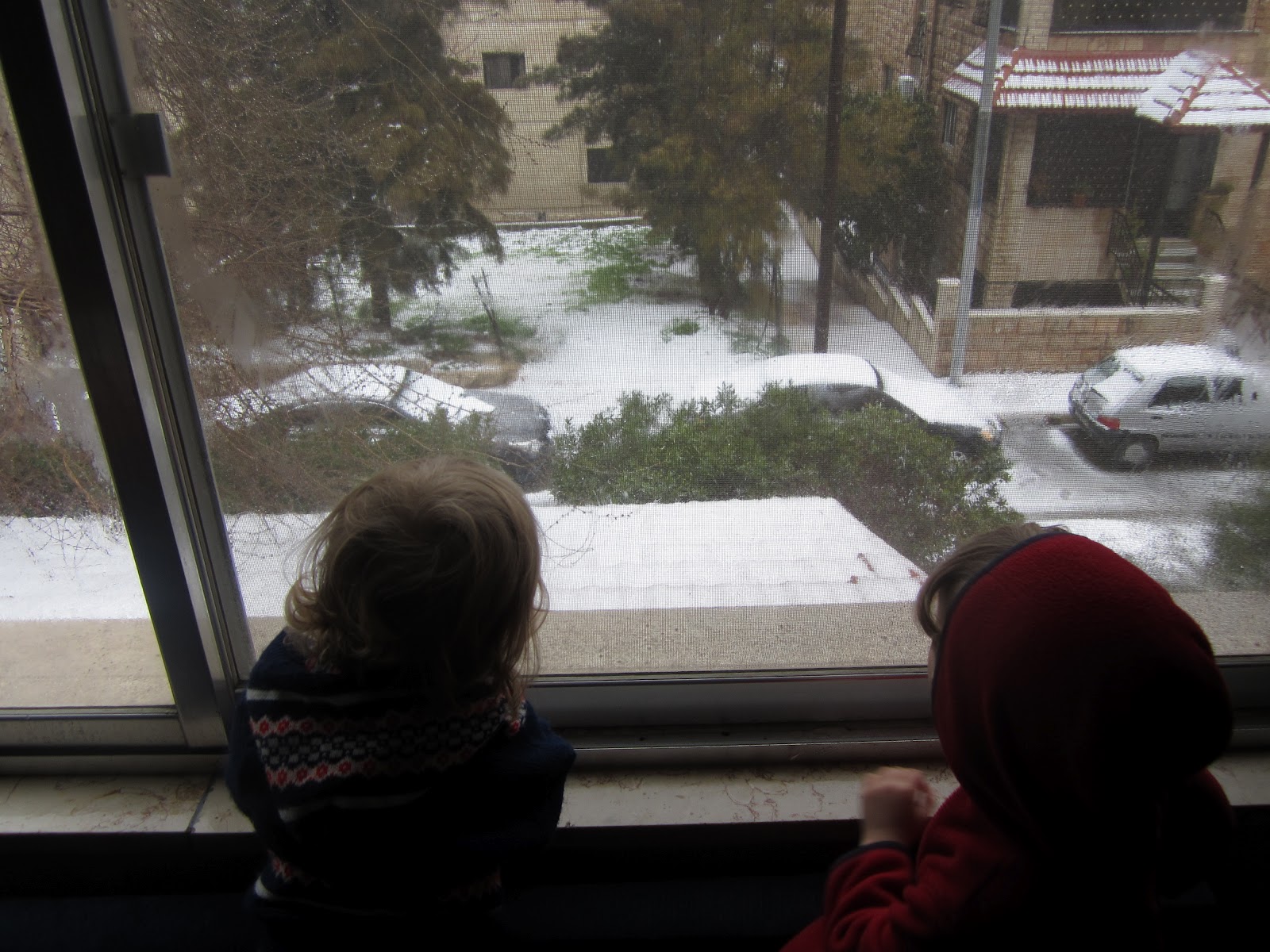
At long last we've returned to Jordan, and have come back to some unseasonably cold winter weather. It's not Minnesota, but overnight temperatures have been hovering at or below 40 degrees Fahrenheit/4-5 degrees Celsius. It's cold, and it's a cold you can't escape from, as the buildings aren't designed for cold weather and often don't even have heat. I visited a neighbor a few days ago and could see my breath in his house, a thick cloud escaping from my mouth as I exhaled. Below are some pictures of Amman covered in snow.


Finally, many cars--including the one we were riding in--were the target of random acts of snowball fun.


Monday, January 02, 2012
Bedouins of Petra
We've been to Petra five or six times, and could go many more times too. Click here to watch a short report CNN did recently about one of the Bedouin families that still live in and around its vicinity.
Saturday, June 11, 2011
Jews and Muslims, Together, Praying for Rain

Last summer was long and hot, not to mention memorable for the extreme water shortages we dealt with for the entire time. Then, when the winter rainy season came--such as it is in Jordan--and it began with very limited precipitation, special times of prayer for rain were organized across the country. The situation was similarly dire across the river in Israel/Palestine, and special times of prayer for rain were organized there too. I mention all this because I came across this photo from last November online today. It features Muslims and Jews praying for rain--together--in a village outside of Bethlehem. And it made me smile. Yes, there is definitely a lot of anger and hatred in the region, but many people are willing to come together and live peacefully with those they are supposed to hate; enmity is not the end of the story. I know this first hand, but it's good to be reminded.
Saturday, June 04, 2011
Jordanian Shade
This was written several years ago, but in honor of summer finally hitting Minnesota, we thought we'd post it again, with a few changes.
All summer here in Amman the temperature has hovered around 90 degrees with occasional forays into the 100s. It is hot, dry and dusty, and many people--if they can--avoid the mid-day heat and simply stay inside. However, because the humidity is not always very high, if you are outside, it is possible to get a decent respite from the heat by walking or resting under the shade of a building, a tree--really, whatever you can find. Yes, it is hot, but finding that elusive shade really can make a big difference in your level of comfort.
Of course many of the stories in the Bible are set in a climate like this, and in my mind the Jordanian heat brings those passages to life. In Genesis, for example, one story has Abraham sitting in his tent "in the heat of the day." When three men come to visit him, he tells them to rest under a tree. These are small details, but because of our time in Jordan I can imagine the afternoon heat experienced by Abraham, as well as the good shade from the heat that the tent and the tree would provide. Also, there is the story of Jonah, who after preaching to the people of Nineveh--a city in what is now northern Iraq, not all that far from us here--left and built himself a little shelter outside the city. It was apparently quite hot, so God raised up a bush to provide shade for Jonah, and to "save him from his discomfort." The next day, though, God caused the bush to die, and Jonah lost his shade. As a result, he became so hot and frustrated that he grew "faint and asked that he might die." Jonah was so hot that he lost his will to live.
Now, I've never been so hot that I wished I were dead, but again, because of our time in Jordan I can imagine how Jonah felt. I think I've felt like that while riding on a windowless bus in the Jordan Valley, the temperature outside of over 100 degrees causing those of us inside to bake, my khaki pants--not shorts, because men must dress modestly too--clinging to the sweat on my legs. I think I've felt like that while walking near the Jordan River, the hot breeze beating down on us like we had just opened a hot oven and all the mighty power of the sun seemingly focused on the straight, naked, part in my hair on the top of my head. I know I've felt like that while trudging Amman for a taxi in the midday summer heat: the streets choked with cars and traffic barely moving, exhaust fumes combining with dust to choke away what's left of the "fresh" air there, a backpack and long pants--modesty, again--serving to cover my body in a sweaty film of claustrophobia, and every taxi maddeningly occupied. Through these--and other--experiences, I can imagine why Jonah was so upset that he lost his shade.
So, as I said, shade can make a big difference, and it is this shade--a shade that can save you from devastating heat--that is good to think about when looking at the imagery used in other parts of the Bible. For instance, Psalm 121 calls God "your shade at your right hand," and Isaiah 25 calls God "a shade from the heat." When I read this, I remember how the other day--when I was outside walking in the heat of the day--I moved immediately into the shadow of a building as soon as I noticed it, how I sought the shade from the heat it would give me. Shade works, and I suppose it is my quick jump into this shade in the heat of a summer day that the various biblical writers had in mind when they referred to God as shade. Like the building, like Jonah's bush, like Abraham's tent, God makes the heat we experience more bearable.
All summer here in Amman the temperature has hovered around 90 degrees with occasional forays into the 100s. It is hot, dry and dusty, and many people--if they can--avoid the mid-day heat and simply stay inside. However, because the humidity is not always very high, if you are outside, it is possible to get a decent respite from the heat by walking or resting under the shade of a building, a tree--really, whatever you can find. Yes, it is hot, but finding that elusive shade really can make a big difference in your level of comfort.
Of course many of the stories in the Bible are set in a climate like this, and in my mind the Jordanian heat brings those passages to life. In Genesis, for example, one story has Abraham sitting in his tent "in the heat of the day." When three men come to visit him, he tells them to rest under a tree. These are small details, but because of our time in Jordan I can imagine the afternoon heat experienced by Abraham, as well as the good shade from the heat that the tent and the tree would provide. Also, there is the story of Jonah, who after preaching to the people of Nineveh--a city in what is now northern Iraq, not all that far from us here--left and built himself a little shelter outside the city. It was apparently quite hot, so God raised up a bush to provide shade for Jonah, and to "save him from his discomfort." The next day, though, God caused the bush to die, and Jonah lost his shade. As a result, he became so hot and frustrated that he grew "faint and asked that he might die." Jonah was so hot that he lost his will to live.
Now, I've never been so hot that I wished I were dead, but again, because of our time in Jordan I can imagine how Jonah felt. I think I've felt like that while riding on a windowless bus in the Jordan Valley, the temperature outside of over 100 degrees causing those of us inside to bake, my khaki pants--not shorts, because men must dress modestly too--clinging to the sweat on my legs. I think I've felt like that while walking near the Jordan River, the hot breeze beating down on us like we had just opened a hot oven and all the mighty power of the sun seemingly focused on the straight, naked, part in my hair on the top of my head. I know I've felt like that while trudging Amman for a taxi in the midday summer heat: the streets choked with cars and traffic barely moving, exhaust fumes combining with dust to choke away what's left of the "fresh" air there, a backpack and long pants--modesty, again--serving to cover my body in a sweaty film of claustrophobia, and every taxi maddeningly occupied. Through these--and other--experiences, I can imagine why Jonah was so upset that he lost his shade.
So, as I said, shade can make a big difference, and it is this shade--a shade that can save you from devastating heat--that is good to think about when looking at the imagery used in other parts of the Bible. For instance, Psalm 121 calls God "your shade at your right hand," and Isaiah 25 calls God "a shade from the heat." When I read this, I remember how the other day--when I was outside walking in the heat of the day--I moved immediately into the shadow of a building as soon as I noticed it, how I sought the shade from the heat it would give me. Shade works, and I suppose it is my quick jump into this shade in the heat of a summer day that the various biblical writers had in mind when they referred to God as shade. Like the building, like Jonah's bush, like Abraham's tent, God makes the heat we experience more bearable.
Tuesday, April 19, 2011
Thoughts on the Revolution
In the time since our last post, we left Jordan to spend Christmas back in Minnesota, then spent a month in Vancouver, Canada visiting family there, then returned to Minnesota, where we will be for several more months before resuming our lives in Jordan. Also in the time since that last post--perhaps you've heard--some major changes have taken place in the region we call home. The governments of Tunisia and Egypt have fallen, protesters continue to march for change in Bahrain, Yemen, Syria and even Jordan and a civil war rages in Libya. No matter how the situations in these countries play out, the Middle East we return to will be much different than the one we left.
And so, since everyone here asks me what I think about all this... here is what I think.
On February 11, 2011, at around six o'clock in the evening in Egpyt, Egyptian Vice-President Omar Suleiman announced the resignation of President Hosni Mubarak after 18 days of massive protests, ending his nearly 30 years of iron-fisted control over the country. Soon after, hundreds of thousands of people began ecstatically celebrating on the streets of Cairo, Alexandria and other cities across Egypt. At around the same time, at about ten o'clock in the morning in Minneapolis, I was parking my car on the street near our old apartment, on my way to a favorite coffee shop, having just heard the news of Mubarak's resignation on NPR. Soon after, I was still in the car. Instead of stepping out to go drink coffee, I stayed and listened, dumbfounded because just the day before Mubarak said he was staying, stunned that this Middle Eastern institution was gone, and happy. Happy for the Egyptians I knew whose futures suddenly seemed ripe with possibility, happy because living in Jordan helped me to envision as I sat there the joy of throngs of smiling Arabs, not just in Egypt, but around the region. Happy because the people had won, and won with class.
I have discovered since then, though, that not everyone here in America is so happy about all of this. Far from being a cause for celebration, the fall of Mubarak--and the many other similar revolts in the region--have been a cause of fear and consternation in some corners. Oh, I've seen some reports which conveyed what I thought was an appropriate sense of the historic and life changing nature of these revolts--especially during the height of the situation in Egypt--but I also saw many other reports that seemed to view them as almost entirely negative. Perhaps naively, this has surprised--and disappointed--me.
On the extreme end of this negativity is what can only be called the "Doomsday Crowd." These people look at what has happened in the region and see not potentially changed lives, but literally world-ending danger. One example of these doomsdayers is Dennis Prager, a conservative radio personality who listed what he called "eight good reasons" for pessimism regarding the revolution in Egypt. These included the possibility of a worse dictator or regime taking Mubarak's place, the historical lack of political and economic freedom in Egypt and the potential of Egypt's increased friendship with Iran. Another is soon to be former Fox News personality Glenn Beck, who spent weeks detailing on his chalkboards how he believed the revolutions were part of a coordinated, global plot of various nefarious left-wing organizations to take over the world. Conservative radio host Rush Limbaugh believed the same, saying that the protests in Egypt were the result of something called "classic community organizing." "And, folks, they're all leftists. They're feminists. They're avowed socialist, leftist, communists, environmentalists," he said. "I don't believe that this is just spontaneity. I think this is classic. This is rent-a-mob. I don't doubt that there are genuine grievances felt by some of the people in this group, but this is not a spontaneous, gee, nobody knew this was coming moment. This is the result of organizing. This is just classic community organizing in Egypt." If you click on the link above, you'll see that he also expressed anger towards some in the media for reporting with amazement that an amazing event had just taken place. I remember listening to it--I was in the car again--and being taken aback at the level of his anger. Finally, there is Fox News host Sean Hannity, who feared the revolt in Egypt may be the beginning of World War III. Doomsday was at hand.
On the kinder, gentler side of this negativity--but negative nonetheless--is what could be called the "What It Means For America" crowd. These kinds of reports again focused not on the potential for positive change for people in Egypt, but instead on the potential for negative change for people in the United States. In other words, these reports turned a story ostensibly about Egyptians and turned it instead into a story about Americans. For example, a headline from CBS Money Watch put the issue bluntly: "What the Egyptian Protests Mean for Your Money." According to Carla Fried, author of the article, the situation in Egypt had caused U.S. investors to ask the "logical question" of "what impact it all might have on their financial lives." Being the Middle East, there were also, of course, many stories having to do with the impact of the revolutions on American gas prices. This angle is captured succinctly in the headline of a story written by Darren Goode of politico.com: "Egypt's Unrest Sparks Fears About Oil."
Another example of the What It Means For America mentality is the concern that the United States would lose a great ally in Mubarak, with the potential that his replacement wouldn't be so friendly to American interests. An article in USA Today asked "Could the U.S. lose a critical ally in the Middle East?" A release by Daniel L. Byman, Senior Fellow at the Brookings Institution think tank on the risks of democracy in Egypt framed the issue with striking honesty: "while deposing Mubarak is clearly what is best for the Egyptian people," he said, "for the United States it is far more problematic." In the days before Mubarak resigned, Limbaugh actually hoped that he would be able to withstand the calls for change. "We need to be rooting for Mubarak," he said, "if you are concerned about U.S. national interests." In what is to me a truly confusing angle to take on this situation, some reporting showed concern that the revolts would spread to other nations in the region. This would, I guess, be the opposite of the reporting that Limbaugh decried above. The same above USA Today article, for instance, asked if there was a risk "that revolt in Egypt will spread to Persian Gulf countries." A risk for who? Finally, numerous reports focused on what the revolt in Egypt meant for Israel--an important question for U.S. interests because we are such strong allies. No link is necessary here; just Google "Egypt, Israel, Unrest" for links as numerous as the sand of the sea.
Now, it's not as if I believe that Egypt is going to magically transform into a beautiful democracy by next week, next year or even five years from now. There will be difficulties, there will be challenges, no doubt; people may suffer in the process. It is also possible that some of the problems raised by the Doomsdayers may come to pass. It may happen, for instance, that a leader worse than Mubarak comes to power. It may happen that all these changes bring only chaos. I am not denying that whatever happens next in Egypt--or elsewhere in the region--could be rough. What I am denying, though, is the placement of these revolts within some sort of sinister plot led by the kinds of groups that the Doomsdayers just happen to despise. I am also denying that theses revolts will bring only chaos, as if that is the only possible result. I am hopeful they bring the changes that Egyptians and others in the region are longing for. Plus, I've been to Egypt and live next door in Jordan; from my experience, a revolution led by environmentalists and feminists wouldn't get very far. Rush is right about one thing, though; ousting Mubarak did take some organizing. However, my major problem with the Doomsdayers is that they just seem so mad about it all.
As far as the What It Means For America crowd is concerned, those kinds of reports just seem to me to be so self-centered. Egyptians are trying to win their freedom? What about my money? What about gas prices? What about our American interests? How will it affect me? How will my life be changed? These concerns turn the focus from Egyptians to us, and make us forget what is really at stake. Along with the Doomsdayers, they make us afraid.
As I said, though, I'm happy. Mubarak ruled his country with an iron fist for 30 years, violently suppressing dissent and free speech, casually allowing corruption to overtake government and society and enriching his pockets. And to top it off, the country is dirt poor; 40 percent of Egyptians live on two dollars or less per day. He was a tyrant, disallowing basic freedoms and opportunities in order to maintain his grip on power, in order to maintain stability. But the people got rid of him. They got rid of Tunisia's corrupt president too, and hardly a shot was fired in either case.
Let's let these people have their moment. Let's try to be happy for them. It's not about our politics or our fears; it's about them. It's about their freedom. I am not afraid. I invite you not to be too.
Tuesday, November 09, 2010
Election Day
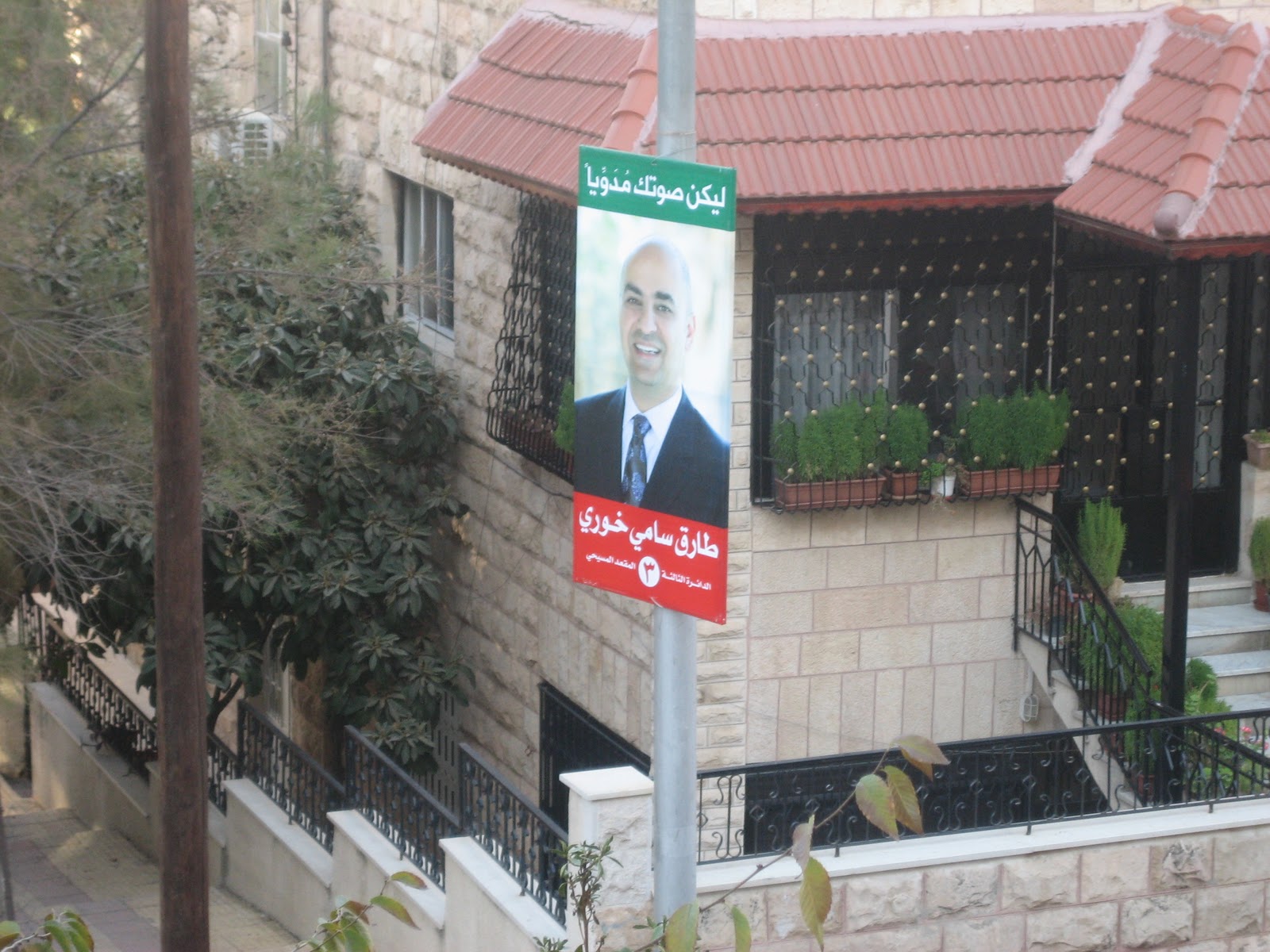
It's election day in Jordan today. Posters and signs are plastered all over Amman, advocating for the various candidates. The pictures below are of Tariq Sami Khoury--a candidate for one of the seats in the legislature reserved for Christians--who has been staring up at us from the street for several weeks now.


Sunday, August 01, 2010
Can't Go Home
*Some friends of mine recently celebrated the 20th anniversary of their graduation from high school. My 20 year reunion is next year, which, thousands of miles away, got me thinking about the subject of going home.
While this house was still being built, I met a boy a year older than me who would be my friend all throughout my youth, and soon met two other boys around my age who would be long term friends too. We spent our daylight hours riding our bikes back and forth on the dirt road, running through the woods, climbing trees, sledding in the winter, eating popcorn, watching Scooby-Doo on TV and playing football and baseball in our big, green yards. Although we each eventually also acquired a group of friends in our own grade, when we got older we stayed friends, and sang in choirs, ran track, hung out at church youth group, occasionally went to movies and even got into a minor car accident or two, one of which was on a different dirt road.
It was in junior high that I first made a few of these other friends. For instance, on the first day of seventh grade art class, the boy I was assigned to share a desk with turned to me out of the absolute clear blue and asked--I'm not sure what was going through his head at the time--if I had seen the 1983 NCAA Basketball Championship Game between North Carolina State and the University of Houston. I had. He would become my best friend growing up, and we spent our time watching basketball, playing basketball, hanging out in his basement, playing tennis all day in the heat of the summer, going to a Twins game instead of Prom and running, running, running. We went our separate ways after graduation, but we remained friends, visiting each other at our colleges, playing and watching more basketball and doing shameful things like attending a Bryan Adams concert.
There wasn't much to do in my small town. There was a dilapidated movie theater of sorts where I remember seeing a Billy Graham movie once, which should tell you all you need to know about the number of new releases that came to town. I went cruising once or twice with some friends, but even that required going to the next town over, as our town only had one stoplight (there are more now). There was the occasional party with the usual underage drinking fiascoes, but I wasn't much interested in that. I mostly spent my time running, especially my last two or so years of high school.
Growing up, I saw the same people day in and day out. You could find most of the kids in my kindergarten class picture in my high school yearbook too. The adults at church I thought were so old--Sunday School teachers, friends of my parents--are still there, and not altogether that old. Some of them came to my wedding--12 years ago today--which was held in the back yard of my parents' country house, the same house we moved into when I was three, the same house where my parents still live.
It would be a shame if I couldn't visit my home town again.
And this, to me, is the crux of the matter in the Palestinian/Israeli conflict: so many people can't go home.
Like the recently retired shop owner up the street from our apartment. At the same age as I was running around in the woods and watching Scooby-Doo, he was running from his home in Jerusalem, dodging explosions and making his way to Amman with his family. He has never been back. Or, like the guy I know who runs a pool hall here. As I left my hometown and went off to college, he also left his--I can't remember which one--to cross the Jordan River and study at the University of Jordan. Unfortunately for him, though, that was in 1967, and the Six-day war broke out soon after he left. He has never been back.
These are just two stories, of hundreds of thousands more, and if you find yourself on the fence on this issue, or unwilling to voice anything but support for Israel, you should think about the people who can't go home. There are around 700,000 from the 1948 Arab-Israeli War and around 300,000 from the 1967 Six-Day War, not to mention their descendants. Because like me, these are people who were raised in a place, made friends in a place and went to school in a place. They ran around the historic, cobble-stoned streets of Jerusalem, played in the waves on the beaches of Jaffa and tended sheep on the lush grass of the Galilee. They saw the same shopkeepers day in, and day out. I even bet some of them, like me, got married at the house they grew up in. Sure, the political leaders of the Palestinians may not be angels, but neither are the Israelis. And once you strip away the political shenanigans and the emotional response to the failed and depraved tactics of suicide bombings and katyusha rockets, as well as the reflexive response by so many in my country to support Israel no matter what the situation, and get to the core of the issue, what you find are people who were forced out of their homes or who fled in fear--villages sometimes razed in the process--and who now can't go back.
I live a long way from my home town right now. I would miss it, though, if I couldn't go back. I would be angry if someone else lived in my home there, after taking it from me. I would be sad that all I had left were the memories. Wouldn't you be?
Wednesday, July 28, 2010
Wow, Water is Great
Water is scarce in Jordan. In fact, I just read today that Jordan is the fourth most water poor country in the world. It's the complete opposite of where we come from in the Land of 10,000 Lakes, where we can shower morning and night, wash the tiniest load of laundry whenever we want, leave the water running while we brush our teeth or shave, hold car-washing fundraisers and run through sprinklers all summer. There, the water flows, well, like water. Here in Amman, though, it does not; it flows like mud. As opposed to a constant supply of water that seemingly will never run dry, most people have a water tank on the roof of their building which holds their weekly supply of water. These tanks are filled once each week when the government turns on the tap, and when the tap is turned off, that is your water for the week. In our neighborhood, this happens on Wednesday.
So, on Wednesdays everyone does all their water intensive projects, while the water is coming in and filling their tank: laundry, all types of cleaning, gardening, maybe an extra long shower. We even flush our toilets more often. Because of this, water day is visibly different from all the other days of the week, with color coordinated laundry flying from all the area rooftops, and people outside hosing down their sidewalk and watering their gardens, all while a stream of water runs maddeningly down the sides of the buildings and down the street, a product of water pipes and tanks riddled with holes. Water day is also audibly different than any other day, with the day-long drain of water sloshing into the metal tanks, the rain-like splashing sound of all the first floor gardens being watered and just the general sound of everyone using water all around us. Below are some of the water tanks on the roof of our building:

Because water is so scarce here--and because we have to work with a weekly allotment of it--from Wednesday to Wednesday we must be careful to conserve. Also, I like to keep an eye on our levels, and every few days I trudge up to the roof to check the progress of our tanks. We've only actually run out of water a handful of times, like when we've had guests. We also have occasionally had problems with rocks in the pipes--thus preventing our water from coming in--and there have been a few times when various problems at the local water station have affected water delivery for the whole neighborhood.
This latter problem happened just recently. Usually on Wednesdays I also like to head up to the roof in the morning to see if the water is coming in, to make sure we can perform our weekly water tasks. This particular Wednesday, though, I did not; I got complacent. Instead, I sauntered up in the early evening after work to discover everyone's water day worst nightmare: a nearly empty tank and a tiny trickle of water dripping in. Our water day was over.
We stopped doing our laundry and just let our tanks fill up. By the time the tap was turned off a few hours later, we had about a third of a tank and the whole week in front of us. So, we spent that week with water conservation dominating our thoughts. We took fewer showers (I got one, maybe two). While showering, we soaped our bodies with the water turned off (just like with shaving, you don't really need the water on the whole time!). We flushed the toilets less. When we did use the faucets, we were aggressive about turning them off quickly. And--in a move that worked out well for me--towards the end of that week, we let the dishes go ("sorry, honey, we just don't have enough water").
In the end, we made it to the next Wednesday, with some sediment in the bottom of our tanks to spare. Below are two pictures of what we had left. As you will see, the water does really flow like mud.


Water is scarce in Jordan, and water was scarce in our house that week. Admittedly, having so little of it for that short time was a little stressful. As a result, when the water came rushing through early the next Wednesday morning as it normally does, relief came rushing through as well. Wow, water is great.
Friday, May 21, 2010
Wadi Zarqa Ma'in
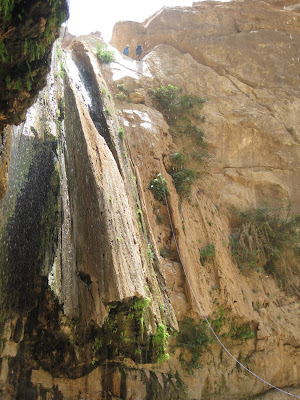
Last week I went hiking in Wadi Zarqa Ma'in (wadi means valley in Arabic), which is one of a series of cavernous valleys in the mountains just to the east of the Jordan Valley and the Dead Sea, many with streams that lead directly into the Dead Sea. Our journey started on a bleak, dusty plateau, before descending into the circuitous path of the valley, where we followed a stream cut through the mountain past enormous boulders, one or two rock slides, pools up to my chin, the occasional palm tree and two abseils off of cliffs about 50 meters high, finishing at Hammamat Ma'in, a famous hot spring just above the Dead Sea popular with tourists and Jordanians alike. Below are some pictures from the day.
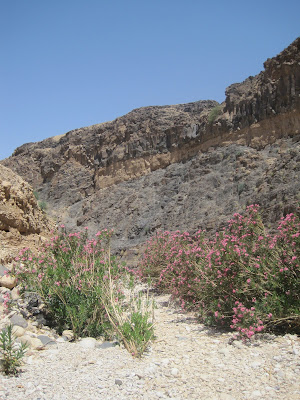
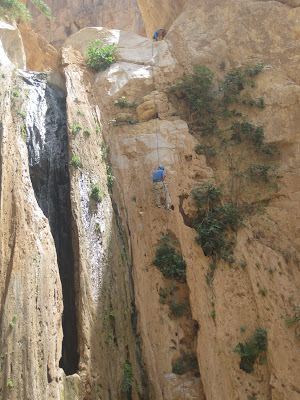

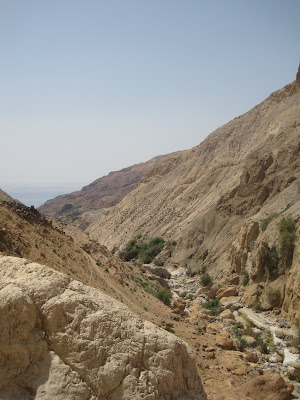
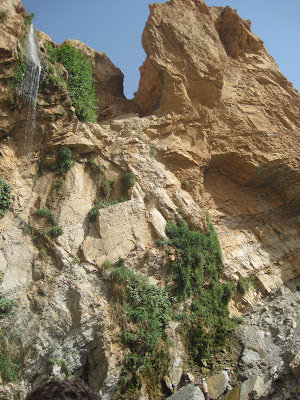
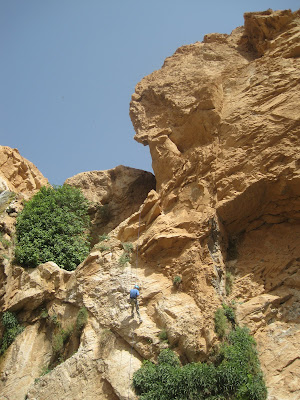
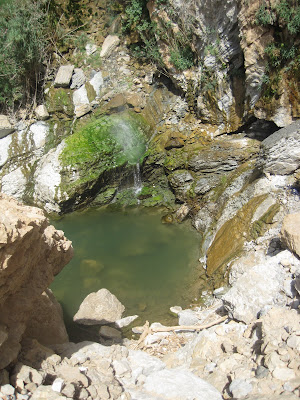

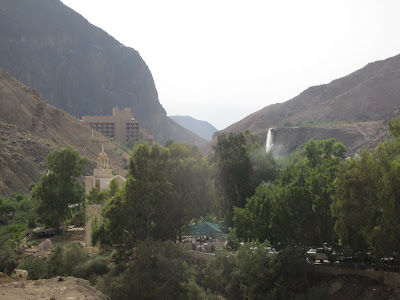

Near the beginning of our hike.

The first abseil. There's a waterfall on the left.

Me going down.

Behind the waterfall.

Looking out towards the Dead Sea above our hiking trail.

The second abseil.

Me going down.

The pool at the bottom.

Another pool near the end of the hike

The hot springs of Hammamat Ma'in, where our hike ended.
Thursday, May 13, 2010
Blue Power
Although I thought the movie Avatar was utterly boring, I guess somebody liked it; I hear it made a fair amount of money at the box office. People love good guy/bad guy stories. I wonder, though, how many people who saw it are aware that it mirrors so many actual events from history, or even current events today. I, for instance, immediately thought of the similarities between the plot--such as it was--and the experience of Native Americans in the United States. Others I talked to thought of European colonization in Africa. These are past events. For many people here, though, the movie spoke to a current event: the Israeli/Palestinian conflict. To them, the blue Na'vi people represented the Palestinians, and the cartoonishly evil marines or contractors--whatever they were--represented the Israeli army.
I was reminded of this connection that some people here in the region made to the movie today when I saw the below pictures, from the British Sunday Telegraph. In them, some protesters in a village near Ramallah are dressed up like the blue Na'vi people, as part of a weekly protest against the separation wall the Israeli government has built. The pictures are from February, so it's old news, but I thought it interesting enough to pass along. I just put a few of the pictures below; to see the rest, click here.


I was reminded of this connection that some people here in the region made to the movie today when I saw the below pictures, from the British Sunday Telegraph. In them, some protesters in a village near Ramallah are dressed up like the blue Na'vi people, as part of a weekly protest against the separation wall the Israeli government has built. The pictures are from February, so it's old news, but I thought it interesting enough to pass along. I just put a few of the pictures below; to see the rest, click here.


Saturday, April 17, 2010
Lies, Lies, Lies
A few days ago a friend was over and gave us some startling news: Jordan's King Abdullah said he regretted his father's 1994 decision to make peace with Israel. He had made the announcement, she said, in a Wall Street Journal Article, which was summarized in an article emailed to her from a friend from some news outlet called "Israel Today." Such news was shocking to me, as it went against what I believe is the king's overall desire for peace and stability in the region, and represented a totally new direction in his sentiment. In fact, I didn't really believe it, so I asked to see the Israel Today Article. So, here it is, pasted below, complete with the headline, "Jordan's King Abdullah Regrets Peace with Israel."
Headline News
Tuesday, April 06, 2010 Israel Today Staff
Jordan's King Abdullah regrets peace with Israel
Jordan's King Abdullah II, widely regarded as the most moderate of Arab leaders, indicated in an interview with The Wall Street Journal published on Tuesday that he regrets his father's decision to make peace with Israel. "Our relationship with Israel is at an all-bottom low. It hasn't been as bad as it is today and as tense as it is today," said Abdullah.
He noted that Jordanians do not see any real tangible benefit from the peace with Israel: "There is no real economic relationship between Jordan and Israel. So economically we were better off in trade and in movement before my father signed the peace treaty."
What Abdullah didn't mention was that according to the peace treaty between the two nations, Israel provides Jordan with a large portion of its annual water needs, and that many Israelis do business in Jordan, even if their Jordanian counterparts choose not to reciprocate.
Abdullah went on to say that recent tension over Jewish building in Jerusalem is highly relevant to Jordan, since it is still recognized as the custodian of Muslim and many Christian holy sites there. However, Abdullah again left the picture incomplete, failing to note that when his country illegally occupied Jerusalem from 1948-1967, it summarily denied Jews and often Christians access to their holy sites.
Abdullah concluded by warning Israel that its future would be at stake if it did not make peace on Arab terms in the very near future. Such saber-rattling from a leader considered Israel's best friend in the Arab world is further evidence of the increasing radicalization of the region, even its more "moderate" elements.
Now, there are a lot of things one could say about this article, but let's start with the most obvious: King Abdullah never said he "regretted" his father's decision to make peace with Israel. He said the relationship between Jordan and Israel is at an all-time low, and he said that Jordanians don't see any economic benefits as a result of the treaty. Regret, though, never entered the conversation. The headline, and the conclusion drawn by the Israel Today staff, is false.
Now let's skip to the last paragraph. Here the staff at Israel Today reports that the king said Israel's "future would be at stake" unless it made "peace on Arab terms", said he was "saber-rattling" and becoming more radical. The paragraph has an ominous feel to it, and Abdullah is portrayed as threatening the very existence of Israel. There's one problem, though: the article provides no proof that he actually said these things. And, after reading the original Wall Street Journal article, I discovered why: he didn't say them. What he did say--when asked the question, "What is your message when you meet with the Israelis?"--was this: "I think the long-term future of Israel is in jeopardy unless we solve our problems." He explained that 57 countries still do not recognize Israel, and that a solution to the Palestinian issue would facilitate recognition, and thus give Israel more stability. He also said that Israel will only find it more difficult to negotiate a solution in a decade or so, when--because of birth rates--the Arab-Israeli population will constitute half of the population of Israel, meaning Israel will no longer be able to negotiate from the position of relative strength that it does now. Nowhere in the original article, though, does the king make any kind of insistence that Israel make peace "on Arab terms," and nowhere does he do anything remotely close to "saber-rattling". In fact, as seen in the above quotation, he referred to "we" solving "our problems."
What he did say in the original article--although not mentioned in the Israel Today recap--was this:
"The extremists around are saying, hey look, nothing is happening, dialogue does not work, communicating with the Israelis is not the way to go forward, the idea of resistance, the spread of fear and hatred is the message they put forward, is the way to go. Even in the Arab Summit in Libya, you had to be careful where some countries were hinting, how long are we going to give you moderates a chance to pursue peace. Because really, look everybody, their way of doing it is not right."
Far from running down the road to radicalism, he was speaking against and warning about those who wanted to forgo a more peaceful peace process. What was asserted about the king by Israel Today was nowhere near what he actually said. It was, instead, lies, lies, lies.
So what does all this matter? Why am I writing about this? According to the Israel Today website, Israel Today exists to provide a "biblical perspective" to Israel based news. Also, a quick Google search revealed that scores of similarly focused websites, blogs and news outlets picked up this story, and ran it whole. I am writing this because the authors are Christians, and they are lying. And their lies are being picked up and swallowed by other Christians. This may sound harsh, but that is what this is. It is lying. As a Christian myself, I find it maddening. It is maddening to me when ideology trumps Christian faithfulness. Unfortunately, if you pay attention to politics at all, you know that this is far from the only example of Christians lying, other Christians swallowing the lie and still other Christians defending the lie.
The situation between the Israelis and Palestinians is complex and tragic. Many people have died, many more have lost their homes and livelihoods, and no one on either side is living the life they could be living as the result of the absence of peace. Telling lies is not helping anyone.
Headline News
Tuesday, April 06, 2010 Israel Today Staff
Jordan's King Abdullah regrets peace with Israel
Jordan's King Abdullah II, widely regarded as the most moderate of Arab leaders, indicated in an interview with The Wall Street Journal published on Tuesday that he regrets his father's decision to make peace with Israel. "Our relationship with Israel is at an all-bottom low. It hasn't been as bad as it is today and as tense as it is today," said Abdullah.
He noted that Jordanians do not see any real tangible benefit from the peace with Israel: "There is no real economic relationship between Jordan and Israel. So economically we were better off in trade and in movement before my father signed the peace treaty."
What Abdullah didn't mention was that according to the peace treaty between the two nations, Israel provides Jordan with a large portion of its annual water needs, and that many Israelis do business in Jordan, even if their Jordanian counterparts choose not to reciprocate.
Abdullah went on to say that recent tension over Jewish building in Jerusalem is highly relevant to Jordan, since it is still recognized as the custodian of Muslim and many Christian holy sites there. However, Abdullah again left the picture incomplete, failing to note that when his country illegally occupied Jerusalem from 1948-1967, it summarily denied Jews and often Christians access to their holy sites.
Abdullah concluded by warning Israel that its future would be at stake if it did not make peace on Arab terms in the very near future. Such saber-rattling from a leader considered Israel's best friend in the Arab world is further evidence of the increasing radicalization of the region, even its more "moderate" elements.
Now, there are a lot of things one could say about this article, but let's start with the most obvious: King Abdullah never said he "regretted" his father's decision to make peace with Israel. He said the relationship between Jordan and Israel is at an all-time low, and he said that Jordanians don't see any economic benefits as a result of the treaty. Regret, though, never entered the conversation. The headline, and the conclusion drawn by the Israel Today staff, is false.
Now let's skip to the last paragraph. Here the staff at Israel Today reports that the king said Israel's "future would be at stake" unless it made "peace on Arab terms", said he was "saber-rattling" and becoming more radical. The paragraph has an ominous feel to it, and Abdullah is portrayed as threatening the very existence of Israel. There's one problem, though: the article provides no proof that he actually said these things. And, after reading the original Wall Street Journal article, I discovered why: he didn't say them. What he did say--when asked the question, "What is your message when you meet with the Israelis?"--was this: "I think the long-term future of Israel is in jeopardy unless we solve our problems." He explained that 57 countries still do not recognize Israel, and that a solution to the Palestinian issue would facilitate recognition, and thus give Israel more stability. He also said that Israel will only find it more difficult to negotiate a solution in a decade or so, when--because of birth rates--the Arab-Israeli population will constitute half of the population of Israel, meaning Israel will no longer be able to negotiate from the position of relative strength that it does now. Nowhere in the original article, though, does the king make any kind of insistence that Israel make peace "on Arab terms," and nowhere does he do anything remotely close to "saber-rattling". In fact, as seen in the above quotation, he referred to "we" solving "our problems."
What he did say in the original article--although not mentioned in the Israel Today recap--was this:
"The extremists around are saying, hey look, nothing is happening, dialogue does not work, communicating with the Israelis is not the way to go forward, the idea of resistance, the spread of fear and hatred is the message they put forward, is the way to go. Even in the Arab Summit in Libya, you had to be careful where some countries were hinting, how long are we going to give you moderates a chance to pursue peace. Because really, look everybody, their way of doing it is not right."
Far from running down the road to radicalism, he was speaking against and warning about those who wanted to forgo a more peaceful peace process. What was asserted about the king by Israel Today was nowhere near what he actually said. It was, instead, lies, lies, lies.
So what does all this matter? Why am I writing about this? According to the Israel Today website, Israel Today exists to provide a "biblical perspective" to Israel based news. Also, a quick Google search revealed that scores of similarly focused websites, blogs and news outlets picked up this story, and ran it whole. I am writing this because the authors are Christians, and they are lying. And their lies are being picked up and swallowed by other Christians. This may sound harsh, but that is what this is. It is lying. As a Christian myself, I find it maddening. It is maddening to me when ideology trumps Christian faithfulness. Unfortunately, if you pay attention to politics at all, you know that this is far from the only example of Christians lying, other Christians swallowing the lie and still other Christians defending the lie.
The situation between the Israelis and Palestinians is complex and tragic. Many people have died, many more have lost their homes and livelihoods, and no one on either side is living the life they could be living as the result of the absence of peace. Telling lies is not helping anyone.
Saturday, March 06, 2010
Nothing Wrong with Sleep
So often here in Jordan it is tempting to focus on the bad. We're thousands of miles from home, in a culture different from ours, with rules and expectations we're still learning--yes, still--which are far removed from the rules and expectations of our own culture. In fact, just the idea that there are rules and expectations at all might be considered a difference in itself. So, as we have written before, it's easy to twist various cultural differences into cultural negatives. Different doesn't always mean bad, though; some things are just different, neither good nor bad, better or worse, than our own culture. Having said this, sometimes we do have bad days--bad days that seem to be related to the culture. And, to be honest, there are some aspects of the culture that we just don't like.
So I've said it; we don't love everything about Jordan, and the Middle East. Some things drive us crazy. Some things make us mad.
Some things we like though. And it is at this point that I feel obliged to give it up for Jordanians--and Middle Easterners in general--for an aspect of their culture that I think they beat my culture on hands down. Simply put, Middle Easterners value sleep more.
What does this mean? Let's start with a quick review of my American culture. In the United States, people talk reverently about what we call the "Protestant Work Ethic." This concept equates working hard with fulfilling ones calling from God, and even worldly success as a sign of salvation. Subconsciously, maybe--or maybe consciously--it places a spiritual value on the idea of work. It also, I think, makes us feel guilty about sleep. One of our most famous idioms is "the early bird gets the worm." In this case I suppose the worm represents our goals or our work, and the moral is that our success in reaching our goals or at work depends partly on our getting out of bed early. And, anecdotally, I think being a "morning person" and waking up early is regarded as a great virtue--especially by those who are morning people--as if a greater blessing was present in the early morning air than in the air at night.
Suffice to say, all of this is not the case in Middle Eastern culture. Middle Easterners (not everyone is an Arab) in general like to start their days a little bit later and end them later, and in between, maybe grab a nap. I have two examples from my life that illustrate this point.
Last week I was in Beirut for a work related training. Everyone involved was from the region, except for me and one other person. It started at ten. Ten! In the States when we have meetings like this, we start so much earlier that ten o'clock is nearly lunchtime. I've been to a few like that myself. Middle Easterners, though, value sleep, and I valued the chance to wake up casually and be wide awake for the meetings.
Also, a few months ago we had our annual meetings here at work. The meetings lasted for three days, and during the last few minutes of the final day when next year's meetings were being planned, the board chair stood up and announced that next year an afternoon snooze would be incorporated into the schedule. I can't remember exactly, but it was planned to be either between 2 and 4pm, or 2 and 4:30. Two hours to sleep! Americans, imagine trying to add a nap to the schedule of your next conference or training. I can't see it. Here, though, it's to be expected. According to the chair, the nap time was being added "because we are in the Middle East." I look forward to next year's meetings, and to being well rested for them.
So, Middle Easterners value sleep. It is fair to say, though, that this cultural characteristic may slowly be dying. Global corporations have brought to Jordan a napless 8 to 5, 6 or 7 workday, and many Jordanian businesses are starting to follow this example. Most everyone I know who runs their own business, though--like the barber down the street, the lamp salesman who just replaced a faulty table lamp we bought from him (who is actually open from 3pm until 1am) and the owners of any little corner store--start late, end late and try to take an extended break sometime in between. It's a cultural trait I value, and one I hope isn't replaced.
So I've said it; we don't love everything about Jordan, and the Middle East. Some things drive us crazy. Some things make us mad.
Some things we like though. And it is at this point that I feel obliged to give it up for Jordanians--and Middle Easterners in general--for an aspect of their culture that I think they beat my culture on hands down. Simply put, Middle Easterners value sleep more.
What does this mean? Let's start with a quick review of my American culture. In the United States, people talk reverently about what we call the "Protestant Work Ethic." This concept equates working hard with fulfilling ones calling from God, and even worldly success as a sign of salvation. Subconsciously, maybe--or maybe consciously--it places a spiritual value on the idea of work. It also, I think, makes us feel guilty about sleep. One of our most famous idioms is "the early bird gets the worm." In this case I suppose the worm represents our goals or our work, and the moral is that our success in reaching our goals or at work depends partly on our getting out of bed early. And, anecdotally, I think being a "morning person" and waking up early is regarded as a great virtue--especially by those who are morning people--as if a greater blessing was present in the early morning air than in the air at night.
Suffice to say, all of this is not the case in Middle Eastern culture. Middle Easterners (not everyone is an Arab) in general like to start their days a little bit later and end them later, and in between, maybe grab a nap. I have two examples from my life that illustrate this point.
Last week I was in Beirut for a work related training. Everyone involved was from the region, except for me and one other person. It started at ten. Ten! In the States when we have meetings like this, we start so much earlier that ten o'clock is nearly lunchtime. I've been to a few like that myself. Middle Easterners, though, value sleep, and I valued the chance to wake up casually and be wide awake for the meetings.
Also, a few months ago we had our annual meetings here at work. The meetings lasted for three days, and during the last few minutes of the final day when next year's meetings were being planned, the board chair stood up and announced that next year an afternoon snooze would be incorporated into the schedule. I can't remember exactly, but it was planned to be either between 2 and 4pm, or 2 and 4:30. Two hours to sleep! Americans, imagine trying to add a nap to the schedule of your next conference or training. I can't see it. Here, though, it's to be expected. According to the chair, the nap time was being added "because we are in the Middle East." I look forward to next year's meetings, and to being well rested for them.
So, Middle Easterners value sleep. It is fair to say, though, that this cultural characteristic may slowly be dying. Global corporations have brought to Jordan a napless 8 to 5, 6 or 7 workday, and many Jordanian businesses are starting to follow this example. Most everyone I know who runs their own business, though--like the barber down the street, the lamp salesman who just replaced a faulty table lamp we bought from him (who is actually open from 3pm until 1am) and the owners of any little corner store--start late, end late and try to take an extended break sometime in between. It's a cultural trait I value, and one I hope isn't replaced.
Subscribe to:
Posts (Atom)