Showing posts with label Jordanian Countryside. Show all posts

Friday, March 29, 2013

Azraq

Recently I fulfilled a years long quest to visit the Azraq Wetlands Reserve, an oasis and migratory bird stop in the middle of a dustbowl about two hours northeast of Amman. As part of the trip we first also visited the nearby Qasr Azraq, a castle originally built by the Romans in the third century. On the way back home, we stopped for tea in a Bedouin tent set up to serve thirsty travelers like ourselves.

Unfortunately, the wetlands are nothing like they once were. This is due in large part to the results of war, as they started to be drained in earnest to provide water for the hundreds of thousands of Palestinian refugees who fled to Jordan from Israel during and after the 1967 Six Day War. There was simply no other source to tap, and the water was siphoned off faster than it could be naturally replaced. So, while at one point the wetlands covered an area the size of Lebanon, now they cover just about five square miles. In ancient times the wetlands were basically an extension of Africa, housing such animals as rhinoceros, hippopotamuses, elephants, cheetahs and lions. Now, there are no animals there, save for a few water buffalo. A few decades ago, hundreds of thousands of migrating birds could be seen there. Now, though, only around a thousand can be seen. The site is now protected and the government is introducing water back into the area, but much of what was lost is never coming back. In fact, war still threatens Jordan's resources. Perhaps up to a million Iraqis fled to Jordan during the peak fighting in their homeland--many of whom remain. In addition to this, several hundred thousand Syrians are now here, having escaped the civil war in their country. No doubt all these people put quite a strain on the infrastructure here, and test the boundaries of Jordan's limited resources. I was interested to see the little that remained of the Azraq wetlands, but being there and seeing what could have been--and what was--just made me sad.


Thursday, March 14, 2013

Wadi Yabis

Recently we took a hike through Wadi Yabis, a valley--wadi means valley in Arabic--that starts high in the mountains of the north and winds its way down to the Jordan Valley, the lowest point on Earth. Located in an area said to have been the homeland of the biblical Prophet Elijah, the valley features a rare perennial spring that we enjoyed walking through, thousand year old olive trees and the elusive Black Iris--Jordan's national flower--which I finally saw in person for the first time. Because it is spring now, the surrounding hillsides were also covered in a thick green that will disappear by the beginning of the summer.


Friday, February 22, 2013

We've Moved to the Country


Made in Damascus, purchased just outside a Palestinian refugee camp, and burning pressed olive tree wood--leftovers that would otherwise be thrown away after the trees are picked and trimmed, so as not to unnecessarily chop down trees in this tree scarce country--we are now heating our new home with this stove, which means we have moved to the country. 

After seven years near Second Circle in Amman, we have left the city for Marj al-Hammam--which in Arabic means "Meadow of Doves"--a small town of around 30,000 people, and about 15 minutes by car from the capital.  At our old apartment, we lived on the second floor in an incredibly densely populated area, with the buildings on either side of us so close we could hear our neighbors washing their dishes, blowing their noses and urinating. Yes, urinating. Now, we live in our own smallish house and have a huge yard ringed by various fruit trees, with no immediate neighbors and one street adjacent to the yard on which--as of 2:50 on this Friday afternoon--no car has been seen today. This will be quite a change.

Sunday, February 10, 2013

Jerash

The Roman ruins of Jerash are about a 30 minute drive north from our home in Amman. Widely considered the most extensive and best preserved Roman city in the region, remains there include a huge arched entrance, a long colonnaded street, a colonnaded oval forum, two big temples, a hippodrome and two amphitheaters where concerts take place still today. It is Jordan's second most popular tourist attraction, after Petra. Like the Citadel, which we wrote about a couple of weeks ago, it's also a great place to run around, which we did recently.


Saturday, May 05, 2012

Pella


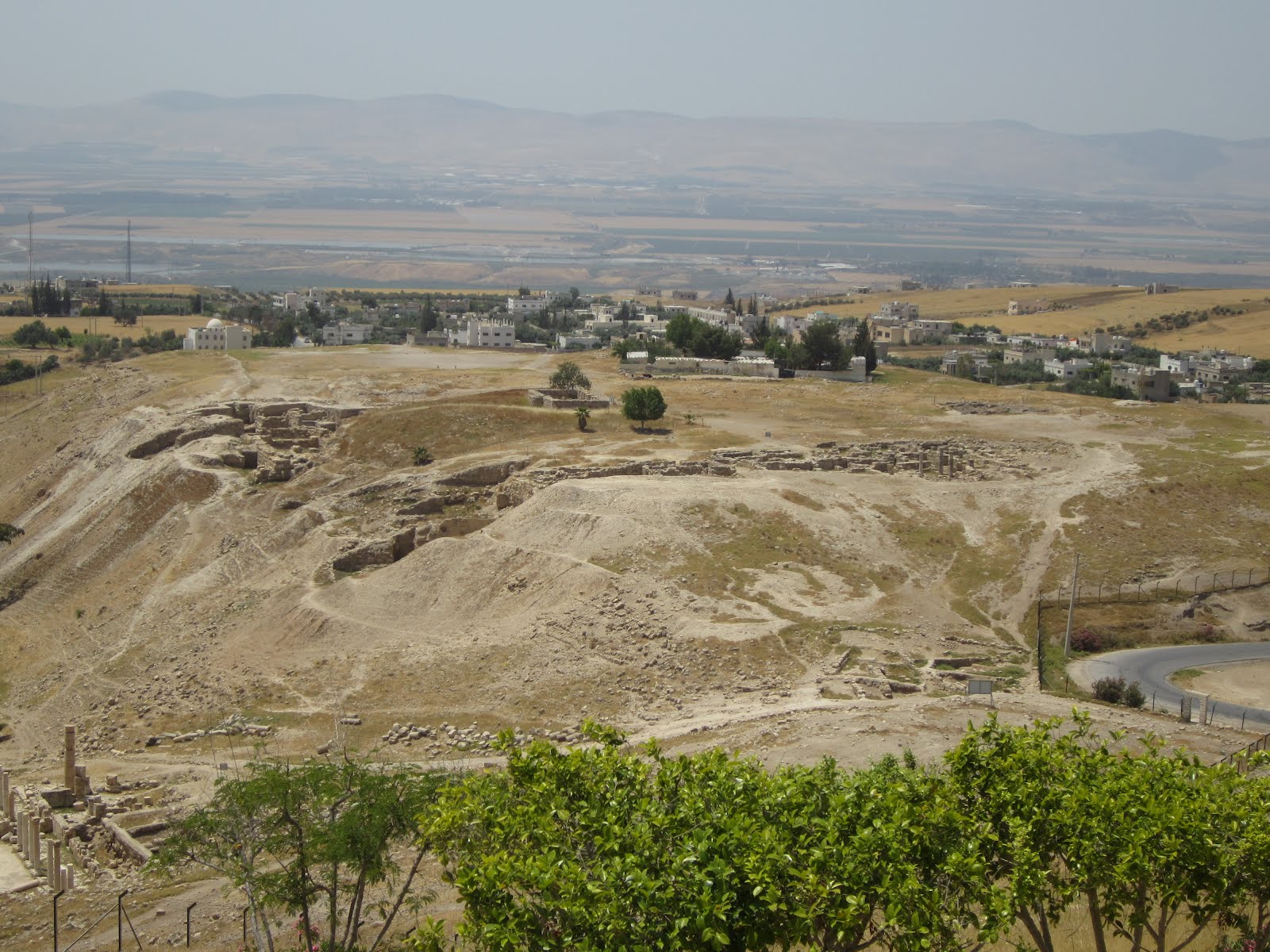
Recently we took a trip to the ruins of the Roman city of Pella, known as Tabaqat Fahl in Arabic. Located in northwest Jordan in the Jordan Valley near the Jordan River, about an hour from Amman, Pella is situated in one of the oldest continuously inhabited places in the world, as it has a Canaanite temple and is mentioned in Egyptian inscriptions as far back as the 19th century BC. In Roman times it was one of the 10 cities of the Decapolis--along with what is now Amman--which were important cities grouped together because of certain similarities in language, culture, location and political status. It has one of the earliest Christian churches discovered, and was also where many Christians from Jerusalem fled during the Jewish-Roman wars of the 1st century AD. Below are some pictures from our day.


Tuesday, March 27, 2012

Scandinavian Forest

In 1989 the late King Hussein donated some land in the rolling, semi-forested hills about 45 minutes to the north from Amman in honor of King Carl XVI Gustaf of Sweden, who had visited the area.  Now called the Scandinavian Forest, periodic tree plants are made there, in the hopes of adding to the tree cover in the nation. We thank both kings, as we had a wonderful picnic in part of the approximately 1200 acre forest over the weekend, enjoying Jordan's greenest season--the few weeks of the year after the winter rains when flowers are blooming and patches of green shoot surprisingly though the rocky soil, before almost everything, eventually, turns to dust.


Monday, January 02, 2012

Bedouins of Petra

We've been to Petra five or six times, and could go many more times too.  Click here to watch a short report CNN did recently about one of the Bedouin families that still live in and around its vicinity.

Friday, May 21, 2010

Wadi Zarqa Ma'in

Last week I went hiking in Wadi Zarqa Ma'in (wadi means valley in Arabic), which is one of a series of cavernous valleys in the mountains just to the east of the Jordan Valley and the Dead Sea, many with streams that lead directly into the Dead Sea. Our journey started on a bleak, dusty plateau, before descending into the circuitous path of the valley, where we followed a stream cut through the mountain past enormous boulders, one or two rock slides, pools up to my chin, the occasional palm tree and two abseils off of cliffs about 50 meters high, finishing at Hammamat Ma'in, a famous hot spring just above the Dead Sea popular with tourists and Jordanians alike. Below are some pictures from the day.


Near the beginning of our hike.


The first abseil. There's a waterfall on the left.


Me going down.


Behind the waterfall.


Looking out towards the Dead Sea above our hiking trail.


The second abseil.


Me going down.


The pool at the bottom.


Another pool near the end of the hike


The hot springs of Hammamat Ma'in, where our hike ended.