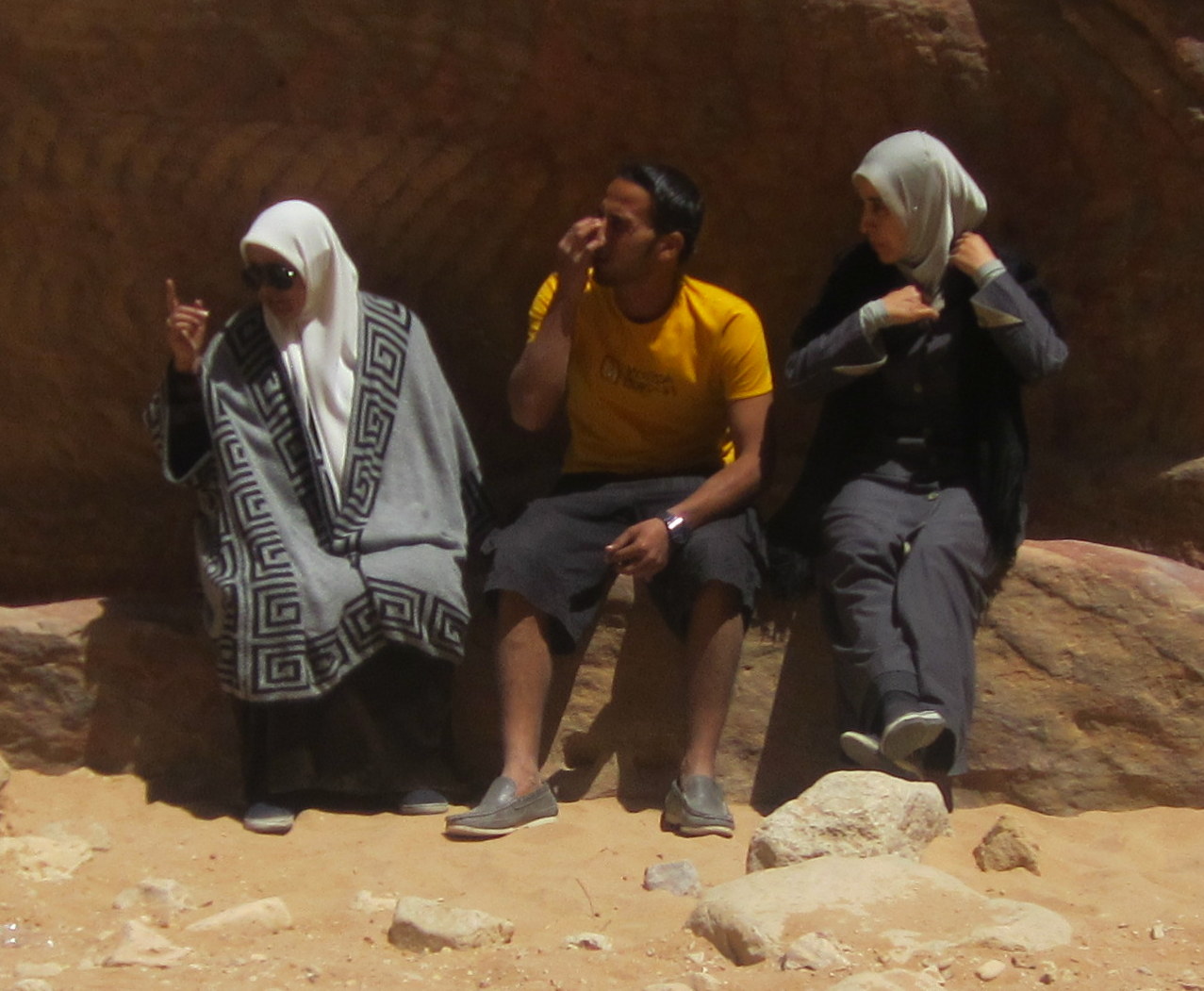
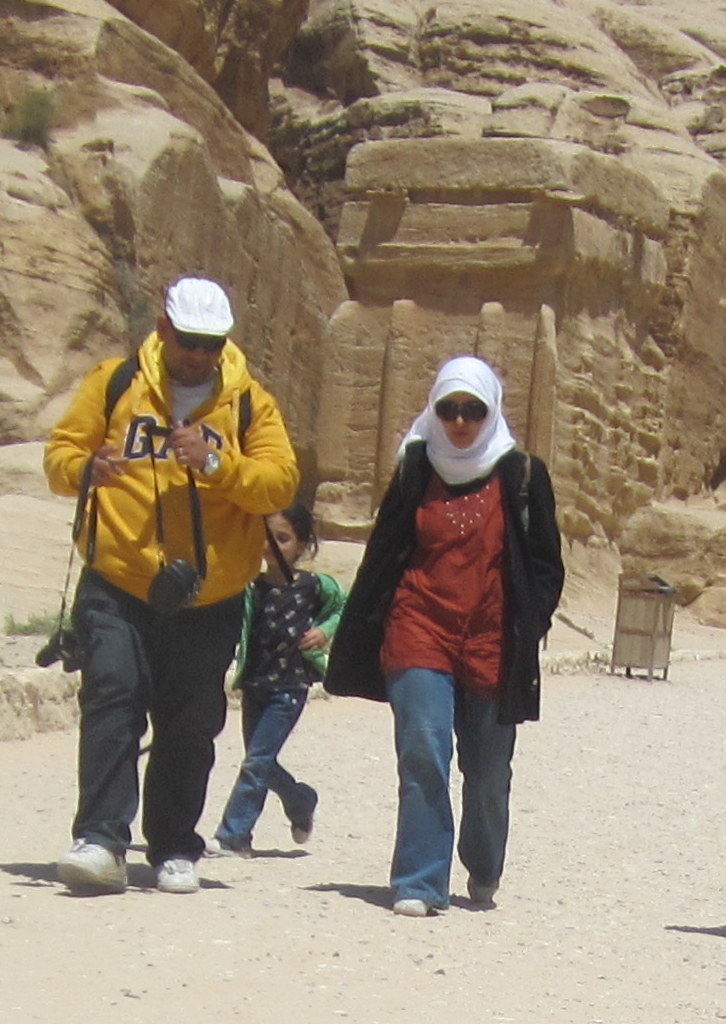
Today we went to Petra with some friends who are visiting us. However, since we've been there six or seven times, I didn't take any pictures of the city meticulously carved into the sides of the mountains, or its beautiful natural surroundings. There were a ton of tourists there, though--far, far more than I had ever seen before--so instead I snapped pictures of them, the people of Petra. A lot of strangers have taken my picture over the years here, so today, I decided it was time for me to do the same.
Saturday, April 20, 2013
Sunday, April 14, 2013
The Qur'an: Arrangement and Structure
A couple months ago we posted an entry on the basic definition of the Qur'an, which you can read by clicking here. Below is a follow-up to that post, on the arrangement and structure of the Qur'an. At some point, there will be two or three more, dealing with other issues related to the Qur'an.
As defined in the previous post on the Qur'an, Muslims believe that the Qur’an is the written record of
revelations from God given orally to the Prophet Muhammad by the angel Gabriel over a period
of about 23 years. These revelations are
divided in the Qur’an into 114 separate units, called Surahs, ranging in length
from 3 to 286 verses, called ayas. According
to the famous Persian Qur'anic commentator and historian Al-Tabari (838-923), the word Surah, which in English is translated as chapter, can
come from two sources. First is from the
root suur (سور), which means to enclose, fence in, wall in
or surround with a railing or wall. It
is from this root that the word for the type of wall that surrounds a home or a town—like that which
surrounds the old cities of Damascus or Jerusalem —comes, separating what
is inside from what is out. It is like
“the wall of a town,” he says, “meaning
the wall which encircles it, because of its elevation over what it surrounds.” Also, al-Tabari said Surah could come from
the root sa'er (سئر), which means to remain or be
left. It is from this root that the word suu'ra (سؤرة) comes, meaning that which is leftover.
Those who read the word this way, he says, define surah as “the part
which is left in the Qur’an over the rest of it, and which is retained." Or, in the words of the 20th century Lebanese scholar Mahmoud Ayoub, “the better
portion of a thing or separate sections, that is, a chapter.” Either way, a clear separation between
readings and into different units is denoted.
“Thus the word signifies a distinct section of the Qur’an separated from
what is before and after it,” says Ayoub. Regarding the word aya (آية), although translated into English as verse, it refers to that which
points to something else, or sign. In fact, besides this particular use of the word aya, the
Qur’an spends a great deal of time referring to the signs of God in nature
and the world. For example, Surah 42:29
says, “and of His signs (ayat) is the creation of the heavens and the earth and what
He has spread forth in both of them of living beings.”
Except for the opening surah, the surahs in the Qur'an are
ordered roughly—but not exactly—by length, from the longest to
the shortest. Each surah has a name—such
as The Criterion (25), The Pilgrimage (22), The Iron (57) and The Cow (2)—which comes from a prominent word or theme in the Surah. Sometimes, though, the name comes from a word
or theme that actually is not so prominent, as in the case of The Poets (26), which is 227 verses long, and the poets from which the surah gets its name
are not mentioned until verse 224. There
are also several Surahs that simply begin with certain individual Arabic letters and are given names that coincide with these letters. Muslims know the Surahs by these names, not
their numbers. Muhammad spent time in the cities of both Mecca and Medina, and each Surah is explained as
either having been from Muhammad’s Meccan or Medinan period, even though some
Meccan Surahs include ayas said to have been revealed in Medina , and vice versa. Generally, Meccan surahs are believed to be
those that are shorter in length—especially those near the end of the
Qur’an—and that speak more about broad themes, such as judgment, warning,
heaven and hell, belief in God and God’s signs, whereas the Medinan surahs are
believed to be of the longer variety and include more specific items regarding
rules, regulations and legislation. Finally,
except for The Repentance (9), each surah begins with the words, “in the name of God, the most Gracious, the most Merciful.”
And what about the material contained within these
surahs? What is the content of the
Qur’an? Without getting into too much
detail here, according to Egyptian-born professor of Islamic Studies at the School of Oriental and African Studies (SOAS) in London, Muhammad Abdel
Haleem, "quantitatively speaking, the Qur’an consists of the various beliefs of
Islam by far, followed by moral issues, ritual aspects, and then legal
provisions." According to Ayoub, “The
Qur’an, broadly speaking, consists of moral and legal precepts, commands and
prohibitions with regard to lawful (halal) and unlawful (haram) actions,
promise (wa’d) of paradise for the pious and threat (wa’id) of punishment in
hell for the wicked. It also contains
reports of bygone prophets and their peoples, parables, similes and metaphors,
and admonitions. Finally, it sets forth
for the pious obligations (fara’id) of prayer, fasting, almsgiving, the rites
of pilgrimage, and struggle (jihad) in the way of God.”
It is important to know, though, that the Qur’an is not
laid out in a neat, orderly fashion, with, for example, beliefs in one section,
stories of ancient prophets in another, and ritual aspects and legal provisions
in other sections. The Qur’an is not
arranged in the form of a narrative, like the biblical books of Genesis or Exodus, or
like the Gospels of Matthew, Mark, Luke and John. In fact, just one Surah—Yusef/Surah 12,
which deals with the same Joseph (called Yusef in Arabic) from the book of Genesis—can really be
considered to be in story form. Its contents
are not arranged chronologically, or by theme or subject matter. Instead, many Surahs in fact have several
subjects, and may switch rapidly back and forth several times between subjects,
themes and/or stories involving various prophets, people and past events along with events contemporary to Muhammad. “The Qur’an is not like a legal
textbook that treats each subject in a separate chapter,” says Abdul
Haleem. “It may deal with matters of
belief, morals, ritual and legislation within one and the same Surah.”
This aspect of the Qur’an’s arrangement has been the
cause of much criticism from non-Arabic speaking—especially Western—readers of
the Qur’an. To such people, the quick
fluctuation between stories and themes makes the Qur’an seem disjointed and
haphazardly put together, and difficult to read. However, Muslims would argue that this
mingling of themes, characters and other aspects emphasizes their
interconnectedness. Also, the mixing
together of various ritual and legislative aspects with ideas about God,
doctrine and other religious beliefs ties everything back to God. “This gives its teachings more power and
persuasion, since they are all based on the belief in God and reinforced by
belief in the final judgment,” says Abdel Haleem.
For example, legal aspects, according to Abdel Haleem, “are
given more force through being related to beliefs, rituals and morals.” To highlight this idea he points to verse 255
in Surah al-Baqara (2), which is a lengthy description of God and God’s
attributes that is preceded by an admonition to give charitably. Also, he points to a section in the same
Surah that deals with divorce, but is broken up at some point by a reminder to
be devoted to prayer. Such mixing is
purposeful, providing for a constant reminder of the various themes and issues
found in the Qur’an. If the Qur’an
followed a more neat thematic, chronological or historical arrangement, he
said, “it would not have had the powerful effect it does by using these themes
to reinforce its message in various places.”
Wednesday, April 03, 2013
No, I Don't Like Your Hair
Before we came to Jordan seven years ago some people suggested I cut my hair. You know, to fit in better, so people in this conservative society wouldn't be turned off by my long locks. Anyway, I didn't cut it, and I've never had any problem. Sure, I get a few more stares than the average white guy here, but I did back at home too, especially from the occasional anxious store clerk who is certain I look like a shoplifter. I've never gotten the sense that people wouldn't talk to me or distrusted me here because I looked different. I have friends young and old, and with varying degrees of religiosity, and the strangers I meet every day are perfectly willing to talk to me. My long hair, though, does set me apart aesthetically from nearly everyone in Jordan. That is true. Because of that, I am every so often forced to answer questions about it, usually from a kid. Such an inquisition took place yesterday, while I was innocently waiting for my shawarma. My inquisitor was around twelve or thirteen years old, and he took a keen interest in how I looked while waiting for his shawarma too. The following is the English translation of our conversation.
Kid: Why is your hair like that?
Me: Why not?
Kid: Why is your hair like that?
Me: Why not? Why is your hair like that?
Pause, confusion.
Kid: Why is your hair like that?
Me: Why is your hair like that? It's too short.
Kid: What?
Me: It's too short.
Pause, again.
Kid: Why is your hair like that?
Me: Why? You don't like it?
Kid: No.
Me: What? Is it prohibited?
Kid: Yes.
I smiled wide, and laughed, and began to consider my next response. But, alas, his shawarma was ready, and he grabbed it and walked away, leaving me alone, with my forbidden hair.
Kid: Why is your hair like that?
Me: Why not?
Kid: Why is your hair like that?
Me: Why not? Why is your hair like that?
Pause, confusion.
Kid: Why is your hair like that?
Me: Why is your hair like that? It's too short.
Kid: What?
Me: It's too short.
Pause, again.
Kid: Why is your hair like that?
Me: Why? You don't like it?
Kid: No.
Me: What? Is it prohibited?
Kid: Yes.
I smiled wide, and laughed, and began to consider my next response. But, alas, his shawarma was ready, and he grabbed it and walked away, leaving me alone, with my forbidden hair.
Friday, March 29, 2013
Azraq
Recently I fulfilled a years long quest to visit the Azraq Wetlands Reserve, an oasis and migratory bird stop in the middle of a dustbowl about two hours northeast of Amman. As part of the trip we first also visited the nearby Qasr Azraq, a castle originally built by the Romans in the third century. On the way back home, we stopped for tea in a Bedouin tent set up to serve thirsty travelers like ourselves.
Unfortunately, the wetlands are nothing like they once were. This is due in large part to the results of war, as they started to be drained in earnest to provide water for the hundreds of thousands of Palestinian refugees who fled to Jordan from Israel during and after the 1967 Six Day War. There was simply no other source to tap, and the water was siphoned off faster than it could be naturally replaced. So, while at one point the wetlands covered an area the size of Lebanon, now they cover just about five square miles. In ancient times the wetlands were basically an extension of Africa, housing such animals as rhinoceros, hippopotamuses, elephants, cheetahs and lions. Now, there are no animals there, save for a few water buffalo. A few decades ago, hundreds of thousands of migrating birds could be seen there. Now, though, only around a thousand can be seen. The site is now protected and the government is introducing water back into the area, but much of what was lost is never coming back. In fact, war still threatens Jordan's resources. Perhaps up to a million Iraqis fled to Jordan during the peak fighting in their homeland--many of whom remain. In addition to this, several hundred thousand Syrians are now here, having escaped the civil war in their country. No doubt all these people put quite a strain on the infrastructure here, and test the boundaries of Jordan's limited resources. I was interested to see the little that remained of the Azraq wetlands, but being there and seeing what could have been--and what was--just made me sad.
Labels:
Jordanian Countryside,
Pictures,
Sites of Jordan
Sunday, March 17, 2013
What Goes Up...
The crackle of not too distant--more than likely celebratory--gunfire as I sat up on our rooftop a few nights ago reminded me of this video from Saudi Arabia I saw recently. We like to commemorate happy occasions by unloading bullets into the sky here in Jordan, and I've found bullets on our old street and on the ground at a nearby park that I'm pretty sure didn't come from drive-bys. I'm also pretty sure that anyone in the area of these guys had to head for cover.
Thursday, March 14, 2013
Wadi Yabis
Recently we took a hike through Wadi Yabis, a valley--wadi means valley in Arabic--that starts high in the mountains of the north and winds its way down to the Jordan Valley, the lowest point on Earth. Located in an area said to have been the homeland of the biblical Prophet Elijah, the valley features a rare perennial spring that we enjoyed walking through, thousand year old olive trees and the elusive Black Iris--Jordan's national flower--which I finally saw in person for the first time. Because it is spring now, the surrounding hillsides were also covered in a thick green that will disappear by the beginning of the summer.
Labels:
Jordanian Countryside,
Jordanian Life,
Pictures
Friday, February 22, 2013
We've Moved to the Country
Made in Damascus, purchased just outside a Palestinian refugee camp, and burning pressed olive tree wood--leftovers that would otherwise be thrown away after the trees are picked and trimmed, so as not to unnecessarily chop down trees in this tree scarce country--we are now heating our new home with this stove, which means we have moved to the country.
After seven years near Second Circle in Amman, we have left the city for Marj al-Hammam--which in Arabic means "Meadow of Doves"--a small town of around 30,000 people, and about 15 minutes by car from the capital. At our old apartment, we lived on the second floor in an incredibly densely populated area, with the buildings on either side of us so close we could hear our neighbors washing their dishes, blowing their noses and urinating. Yes, urinating. Now, we live in our own smallish house and have a huge yard ringed by various fruit trees, with no immediate neighbors and one street adjacent to the yard on which--as of 2:50 on this Friday afternoon--no car has been seen today. This will be quite a change.
Tuesday, February 12, 2013
Webcams Around Jordan
Jordan just installed 24/7 webcams at the Citadel--which we wrote about recently--and at Petra, the Dead Sea and the Red Sea coastal city of Aqaba, plus one of the Amman skyline. We don't know if the Amman view ever changes, but our apartment is just five minutes up the road from what is currently showing. Click this link for the article in the Jordan Times about the initiative, and click here to go right to the webcams. According to the Jordan Tourism Board (JTB), "Jordan is the first country in the Middle East to install tourism webcams."
Labels:
Amman,
Jordan Times,
Jordanian Life,
Pictures
Sunday, February 10, 2013
Jerash
The Roman ruins of Jerash are about a 30 minute drive north from our home in Amman. Widely considered the most extensive and best preserved Roman city in the region, remains there include a huge arched entrance, a long colonnaded street, a colonnaded oval forum, two big temples, a hippodrome and two amphitheaters where concerts take place still today. It is Jordan's second most popular tourist attraction, after Petra. Like the Citadel, which we wrote about a couple of weeks ago, it's also a great place to run around, which we did recently.
Labels:
Jordanian Countryside,
Jordanian Life,
Pictures
Tuesday, February 05, 2013
The Qur'an: Definition
Periodically we try to post about various aspects of the Islamic faith. Several months ago during the month of Ramadan, for instance, we published three separate posts dealing with the the basic meaning of Ramadan, meritorious deeds Muslims can perform during Ramadan, and the importance of fasting for Muslims during Ramadan. Below is the first of several posts dealing with how Muslims view their sacred book, the Qur'an.
Muslims believe that the Qur'an is the written record of revelations from God given orally to Muhammad by the angel Gabriel over a period of about 23 years. Or, in the words of Seyyed Hossein Nasr, Iranian born Professor of Islamic Studies at George Washington University: “The Qur’an for the Muslim is the revelation of God and the
book in which His message to man is contained. It is the Word of God revealed to the
Prophet through the archangel Gabriel.”
The word Qur’an comes from the root qara’a meaning to
read or recite. According to Muhammad Abdel
Haleem, Professor of Islamic Studies at the School of Oriental and African Studies in London, “The word qur’an lexically means
‘reading’ and came to refer to ‘the text which is read.’” While Abdel Haleem emphasizes the aspect of
reading, others, however--such as Nasr--focus more on the
aspect of recitation. This may just be a
difference of semantics, however, since the words were first received orally
and this oral nature is still of prime importance. I have many times seen neighbors, shop
keepers, etc., reading the Qur’an—not silently—but quietly aloud, in a sense
both reading and reciting it at the same time. Also, taxi drivers will often listen to the recited Qur'an while they work. There is also some evidence to suggest the
word Qur’an may come from the root qarana, meaning to collect, although this definition has far fewer adherents.
Whatever the case, either definition—reading or reciting, and
collecting—works. “The book is so called
both because it is a collection of the best religious teaching and because it
is a book that is or should be read,” says Maulana Muhammad Ali, an early 20th century Pakistani scholar who is responsible for a well known English translation of the Qur'an..
The word Qur’an occurs many times in the text, and it may be
used to refer to the full text—the Qur’an as a whole—or just part of the text. The following are some examples of its use:
“It is we who have
sent down the Qu’ran to you by stages.” (76:23)
“Ramadan is the month
in which was sent down the Qur’an…” (2:185)
“It is a Qur’an which
we have divided (into parts from time to time), in order that you might recite
it to men at intervals; we have revealed it by stages” (17:106)
“Be not in haste with
the Qur’an before its revelation to you is completed…” (20:114)
“God has purchased of
the believers their persons and their goods; for theirs (in return) is the
garden (of paradise): they fight in His cause, and slay and are slain: a
promise binding on Him in truth, through the law, the gospel, and the Qur’an.”
(9:111)
As mentioned above, to Muslims, the Qur’an is the word of
God. By the word of God, however, it is
not meant that Muslims believe that the words of the Qur’an are inspired by
God, or that God inspired people to write the words. It means, instead, that Muslims believe the
Qur’an to be God’s very speech, the actual words of God. “To Muslims, the Qur’an is the speech of God,
revealed in word and meaning,” says Abdel Haleem, and “God speaks directly in
the Qur’an.” The Qur’an “is the
transcendent Divine Word which became human speech,” says Mahmoud Ayoub, Lebanese born former Professor of Islamic Studies at Temple University. And finally, according to contemporary South African scholar Farid Esack, Professor of Islamic Studies at the University of Johannesburg, South Africa, “to
invoke the Qur’an is to invoke God. The
Qur’an is God speaking, not merely to Muhammad in seventh-century Arabia , but from all eternity to all humankind.”
To Muslims the Qur’an is the word of God in every
aspect. From the shortest vowel sound to
the concepts conveyed to the form of the book itself, it is all divine, all
from God. “Every letter in the Qur’an is
the word of God, and every sound in it is the true echo of God’s voice,” says
Hammudah Abdalati, author of a well known introduction to Islam. “Both the spirit and
the letter, the content and the form, are Divine,” says Nasr. “Not only the content and meaning comes from
God but also the container and form which are thus an integral aspect of the
revelation.”
Muslims do not believe, though, that as the word of God, the
Qur’an was conceived of or created by God at the moment of its revelation, or
at any other time, for that matter.
Instead, Muslims believe the Qur’an to be eternal—always existing—and
uncreated. This was not always the case,
as early on opinions differed as to the question of the createdness or
uncreatedness of the Qur’an. Also, for a
time in the early to mid ninth century the createdness of the Qur’an was
official doctrine of the Islamic state, and those holding the opposite view were sanctioned
and the subject of persecution. However,
after this time, the view of the eternal uncreatedness of the Qur’an won out, along
with the concomitant view that its recitation, reading, writing or hearing by
humans was also the uncreated Word of God.
“The Qur’an is the speech of God, the revelation of what He spoke. It is uncreated,” said the Palestinian scholar Ibn Qudama (1147-1223). “Whatever is recited of it, or chanted or
heard or written, in whatever form, is the uncreated speech of God. This includes the surahs and the verses, the
words and the letters…”
This became the official and consensus view of the state and
religious establishment, and became such an important part of Islamic beliefs
that denying this uncreatedness became equated with unbelief. According to the Iraqi Abu Hanifa, the 8th century founder of one of the four main schools of Sunni Islamic law, “the
Qur’an is the speech of God—exalted be He—uncreated… Whoever says that the
speech of God—exalted be He—is created is a disbeliever in God.” The Egyptian scholar Al-Tahawi (843 or 853-935) in his well known creedal statement said that
“[the Qur’an] is not something created such as the speech of mankind. So whoever hears it and claims it is the
speech of a human, then he has committed Unbelief.” And finally, according to the 12th century Iraqi scholar Ibn al-Jawzi, “the word of God is not created… The repetition of
the word of God by created beings does not make it created because that speech
is in its essence still the speech of God and it is uncreated. So, in every situation, repeated or memorized
or written or heard, it remains that way.
Anybody who says it is created in any way is an unbeliever whose blood
may be shed after he has been called on to repent [and refused].”
Muslims believe not only that the Qur’an is the uncreated
speech of God, but also that the original copy of the Qur’an—the “original
archetype” in the words of Ayoub—is with God in heaven in what is referred to
in the Qur’an as “The Preserved Tablet” and the “Mother of the Book.” This idea is found in the following places:
- Surah 85, verses 21-22: "Nay, this is a glorious Qur’an, (inscribed) in a Tablet Preserved!"
- Surah 43, verses 3-4: "We have made it a Qur’an in Arabic that you may be able to understand (and learn wisdom). And verily, it is in the Mother of the Book, in Our Presence, high (in dignity), full of wisdom."
- Surah 13, verse 39: "God blots out or confirms what He pleases: with Him is the Mother of the Book."
Some consider this book to consist exactly of what is found
in the Qur’an. It “is often regarded as
the original copy of the Qur’an,” said Esack. However, others believe it to be the repository of all the revelations
that have ever come from God. 20th century Pakastani scholar Abul A’la Maududi, who was a great influence on contemporary Islam, for instance, calls the Mother of the Book
“the Original Book which is the Source and Origin of all the revealed
Books.” Also, 12th century Persian scholar al-Zamakhshari, who wrote a famous commentary on the Qur'an, says “The original text is the tablet corresponding
to the words of God: ‘No, it is a glorious Qur’an, in a well-preserved
tablet’. This writing is designated umm
al-kitab because it represents the original in which the (individual) books are
preserved. They are taken from it for
copying.”
Connected to the belief in the Qur’an being the strict,
direct and actual words of God, it is important to understand that Muslims
believe that it is entirely the words of God.
Muhammad had no part in their formation; he was simply the vehicle by
which God made God’s words known to humans.
“The Prophet was purely passive in the face of the revelation he received
from God. He added nothing to this
revelation himself,” says Nasr. “He did
not write a book but conveyed the Sacred Book to mankind.” In the words of al-Tabari (838–923), an influential historian from modern day Iran, the Qur’an is a
revelation that “God caused to descend upon” Muhammad and, in fact, the phrase
“sent down” in a variety of forms is employed over 200 times in the Qur’an in
reference to itself. As a result, Muhammad
is viewed to have been like an empty vessel or pitcher that, when filled up
from on high, would pour out the words of the Qur’an for those around him. However, he is not viewed to have been the
originator of those words; he simply offered what was given to him by God. Echoing Nasr, Abdel Haleem says of the Qur’an that
“Muhammad is no more than its receptacle.
God is the one who speaks in this book.
The Prophet is the passive recipient of a revelation over which he has
no control.”
So we have established what Muslims view the Qur’an to
be, and have settled on a kind of basic definition of it. In order to further define and understand its
purpose for Muslims, though, it will be helpful to briefly look at the other
common names by which it has been called over the years, names which are found
in the Qur’an itself. Maulana Muhammad
Ali in the introduction to his English translation of the Qur’an has listed 21
such names—again, all found throughout the Qur’an—among them being the
Admonition (10:57), the Judgment (13:37), the Goodness (3:103), the Clear
Argument (4:175), the Revelation (26:192) and the Light (7:157). These names all give additional clarification
as to how Muslims view the Qur’an.
However, in addition to al-Qur’an, three other names have
commonly been used by Muslims as what could be called alternative names for the
Qur’an, names which again are found in the Qur’an and which provide further
detail regarding a definition, explanation or description of the Qur’an. According
to al-Tabari, along with Qur’an they make up the four names given by God for God’s
revelation. One of these is kitaab,
which comes from the root kataba meaning to write. According
to Abdel Haleem, “The Muslim scripture often calls itself ‘kitaab’: lexically,
this means ‘writing’ and came to refer to ‘the written book.’” This appellation also occurs often in the
Qur’an, a prime example being Surah 2:2: “This is the book, in it is guidance
sure, without doubt, to those who fear God.”
After this are two more descriptive names used in the text: al-dhikr and al-furqaan. Below are a few short explanations concerning
the meaning of these names by some of the Muslim thinkers we have been
referencing, along with a verse from the Qur’an in which the name is used.
Al-Dhikr/The Reminder
Surah 15:9: “Surely we
have revealed the reminder, and surely we are its guardian.”
al-Tabari: “As for the
interpretation of its name ‘Dhikr’, there are two possible meanings. One is that it is a reminder from God by
which he reminds His servants, and in which he informs them of His restrictions
and impositions, as well as the other judgments He lays down. The other meaning is that it is a citation,
and ennoblement, and an honor, for whoever has faith in it and believes what is
in it.”
Al-Furqaan/The Criterion
Surah 25:1: “Blessed
is he who sent down the criterion to his servant, that it may be an admonition
to all creatures.”
Ayoub: “The Qur’an has
also been called al-furqaan (the criterion distinguishing truth from falsehood
or error).”
al-Tabari: “Our
opinion about the origin of furqaan is that it is a separation between two
things, a disjunction between them. This
can be [effected] by a judgment, a deliverance, the manifestation of a proof,
or a victory, as well as by any other means.
Thus clearly shows that the Qur’an is called the Furqaan because it
separates the one who is right from the one who is wrong by its proofs, its
evidence, its delimitation of religious obligations, and by its other meanings
which judge between who is right and who is wrong.”
Nasr: “It is also a
furqaan or discrimination in that it is the instrument by which man can
come to discriminate between truth and falsehood, to discern between the real
and the unreal, the absolute and the relative, the good and the evil, the
beautiful and the ugly.”
Finally, we will
add one more piece to our definition and understanding of the Qur’an. The Qur’an is many things and covers many
topics, as its contents include issues relating to the various practices,
doctrines and beliefs of Islam. It is
probably safe to say, however, that the number one goal of the Qur’an—and of
everything in the Qur’an having to do with practices, doctrines and beliefs—is guidance,
guidance that leads to God. “God has made everything in the Qur’an… a guide for
His servants towards His pleasure, that which will lead them to the Garden,”
says al-Tabari, and Ayoub says the Qur’an’s “primary function” is “to guide
people to God.” Al-Tabari also says of
the Qur’an:
“[God] made this
Revelation a brilliant light in the obscurity of ignorance, a lustrous star in
the twilight of uncertainty, a sure guide against wandering in the ways of
confusion, and a leader on the paths to salvation and truth… Its pillars will
[never] crumble, its way-marks will [never] be obliterated by the span of time;
he who follows it will not deviate from the goal of the path, he who journeys
with it will not wander from the way of guidance; he who complies with its
direction will attain success and will be well directed, but he who strays will
take the wrong turning and lose his way.
[This Revelation] is the refuge to which [those who are guided by it]
repair in case of differences; it is the stronghold to which they resort in
times of adversity, the fortress in which they entrench themselves against the
whisperings of Satan, the wisdom of their Lord in which they seek arbitration,
the [binding] decision of His judgment between them to which they ultimately
have recourse and in accordance with which they act; [it is] His cable by
clinging to which they are saved from destruction.”
There are a
plethora of passages in the Qur’an that refer to it as a guide, parts of some of
which are written below:
Surah 31:2-3: “These
are the verses of the wise book, a guide and a mercy to the doers of good.”
Surah 27:1-2: “These
are verses of the Qur’an, a book that makes things clear; a guide, and glad
tidings for the believers.”
Surah 61:9: “It is he
who has sent his messenger with guidance and the religion of truth…”
Ayoub also bases his
judgment on the fact that the Qur’an opens with a prayer for guidance in Surah
1; then, this surah is followed by the aforementioned Surah 2:2, with
another reference to guidance: “This is the Book: in it is guidance sure,
without doubt, to those who fear God.” Maududi in his commentary of the Qur’an points out this prayer or request for guidance in Surah 1
and—since it is the first Surah in the Qur’an—calls the rest of the Qur’an the
response to it. Below is the whole of this first Surah, followed by Maududi’s explanation of it, with a very clear
explication of what he believes the Qur’an to be, based on his analysis of the
surah that opens it.
In the name of God,
Most Gracious. Most Merciful.
Praise be to God,
the cherisher and sustainer of the worlds;
Most gracious, most
merciful;
Master of the Day
of Judgment.
You do we worship,
and your aid do we seek.
Show us the straight way.
The way of those on
whom you have bestowed your grace, those whose (portion) is not wrath, and who
do not go astray.
This Surah is named Al-Fatihah because
of its subject-matter. Fatihah is that
which opens a subject or a book or any other thing. In other words, Al-Fatihah is a sort of
preface.
This Surah is in fact a prayer which
Allah has taught to all those who want to make a study of His book. It has been placed at the very beginning of
the book to teach this lesson to the reader: if you sincerely want to benefit
from the Quran, you should offer this prayer to the Lord of the Universe.
This preface is meant to create a
strong desire in the heart of the reader to seek guidance from the Lord of the
Universe, Who alone can grant it. Thus
Al-Fatihah indirectly teaches that the best thing for a man is to pray for
guidance to the straight path, to study the Quran with the mental attitude of a
seeker-after-truth and to recognize the fact that the Lord of the Universe is
the source of all knowledge. He should,
therefore, begin the study of the Quran with a prayer to him for guidance.
From this theme, it becomes clear that
the real relation between Al-Fatihah and the Quran is not that of an
introduction to a book but that of a prayer and its answer. Al-Fatihah is the prayer from the servant and
the Quran is the answer from the Master to his prayer. The servant prays to Allah to show him
guidance and the Master places the whole of the Quran before him in answer to
his prayer, as if to say, "This is the Guidance you begged from Me."
Friday, January 25, 2013
The Citadel: Our Local Park
Amman has very little green space and we live in a first floor apartment, so we don't have a lot of options for outside play, or for just enjoying the outdoors in general. What Amman does have, though--and Jordan in general--are amazing, ancient archaeological sites. These act as our parks, and we take occasional trips to those nearby when we want to spend a nice day outside.
Recently we went to the Citadel, which is a hill overlooking downtown Amman, which we can see every day from the roof of our building, or from the end of our street. The Citadel lays claim to being one of the oldest continuously inhabited places in the world, as evidence there reveals the presence of settlement activity stretching to over 7000 years ago. It is said to have been the location of the capital of the Ammonites--frequent adversaries of the Israelites in the Old Testament--where King David sent Uriah the Hittite to his death to cover up his affair with Bathsheba. The remaining ruins, though, are mostly more recent, including a Roman Temple to Hercules, a Byzantine era basillica, and a mosque, water cistern and palace complex built by the Umayyads, the first Islamic dynasty, who ruled from 661-750. This is the Citadel--our local park.
Subscribe to:
Posts (Atom)